The Entourage Effect
Last Updated
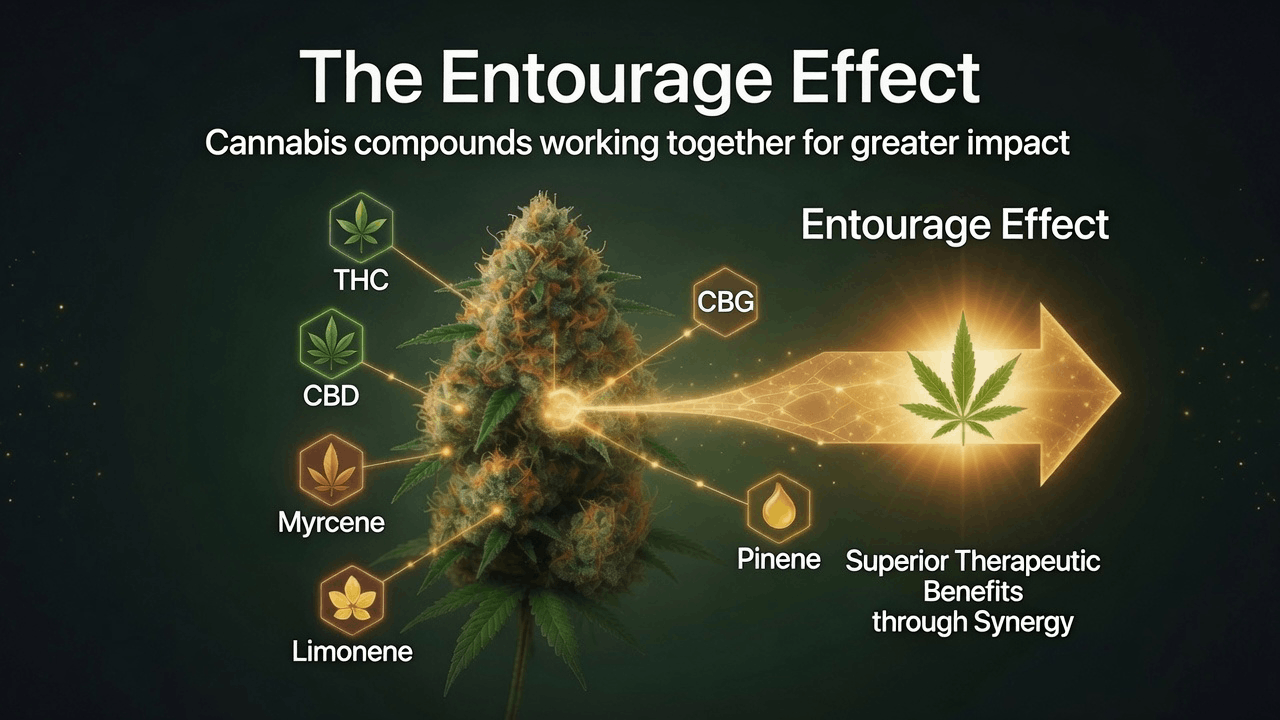
The entourage effect describes how cannabis cannabinoids and terpenes work synergistically for enhanced therapeutic outcomes beyond isolated compounds. Emerging evidence supports whole-plant benefits.
Introduction
Cannabis is not a single-molecule medicine. The plant produces over 100 identified cannabinoids, more than 200 terpenes, and dozens of flavonoids, each with distinct biological activity. For decades, researchers have observed that whole-plant cannabis preparations often produce different therapeutic outcomes than isolated compounds, an observation that gave rise to the concept known as the entourage effect. First articulated by Raphael Mechoulam and Shimon Ben-Shabat in 1998, the hypothesis proposes that the combined action of these compounds produces effects greater than, or qualitatively different from, any single constituent acting alone. [^2]
This idea has profound implications for cannabis product development. If the entourage effect is real and clinically meaningful, the specific cannabinoid and terpene profile of a product, including its ratio of THC to CBD and its concentration of myrcene versus limonene versus beta-caryophyllene, matters as much as the dose of any individual compound. The future of cannabis medicine, under this framework, lies not in isolated pharmaceutical molecules but in carefully characterized, standardized whole-plant extracts and formulations.
Until recently, testing this hypothesis rigorously has been nearly impossible. Under Schedule I of the Controlled Substances Act, U.S. researchers faced severe restrictions on the types of cannabis materials they could access, the scale of trials they could conduct, and the product formulations they could test. [^3] The December 2025 executive order directing rescheduling of cannabis to Schedule III changes this landscape significantly. While DEA rule-making remains ongoing, the shift acknowledges cannabis's medical utility and is expected to streamline access to research-grade materials, expand federal funding eligibility, and allow multi-center trials that can test specific cannabinoid-terpene combinations against isolated compounds under controlled conditions. [^4]
The field has moved from anecdotal observation to increasingly rigorous science. The foundational preclinical data is now substantial, the first human entourage trials have been published, and regulatory barriers are beginning to fall. What follows is an evidence-based assessment of where the science stands, where it falls short, and what the coming generation of research can realistically achieve.
Fast Facts
- Cannabis produces over 100 cannabinoids and 200+ terpenes, creating a complex pharmacological matrix that varies by cultivar and growing conditions. [^1]
- The entourage effect was first proposed in 1998 by Mechoulam and Ben-Shabat, based on observations that endocannabinoid activity was modulated by co-occurring inactive lipids. [^2]
- A 2018 meta-analysis of 670 epilepsy patients found CBD-rich whole-plant extracts effective at one-quarter the dose of purified CBD, with fewer adverse effects. [^5]
- In 2024, a Johns Hopkins double-blind crossover trial demonstrated that the terpene d-limonene dose-dependently reduced THC-induced anxiety without altering THC's other effects, the first controlled human evidence of a specific cannabinoid-terpene interaction. [^6]
- A 2018 preclinical study found that a botanical cannabis preparation was more potent than pure THC against breast cancer cell lines, though the effect was not attributable to the five most abundant terpenes alone. [^7]
- In a 2010 multicenter RCT of 177 cancer pain patients, a THC:CBD extract produced significant pain relief over placebo, while THC extract alone did not reach statistical significance. [^8]
- As of 2024, no clinical trial has been specifically designed to validate the entourage effect in medicinal cannabis, according to a comprehensive systematic review. [^9]
Current Evidence and Gaps
The Foundational Science
The biological basis for the entourage effect rests on the complexity of the endocannabinoid system. THC and CBD interact with CB1 and CB2 receptors but also modulate numerous other targets, including serotonin receptors, TRPV1 channels, GPR55, and PPARγ. [^10] CBD does not directly bind CB1 but can modulate THC's activity at that receptor through negative allosteric modulation, potentially reducing some adverse effects while preserving therapeutic benefits. [^11]
Terpenes add another pharmacological layer. Beta-caryophyllene is a selective CB2 agonist, a rare example of a dietary terpene that directly activates a cannabinoid receptor, and it has demonstrated anti-inflammatory activity in preclinical models. [^12] A 2021 study published in Scientific Reports found that several cannabis terpenes, including alpha-humulene, beta-pinene, and geraniol, produced CB1-dependent antinociceptive effects in mice, with some terpenes matching or exceeding the potency of synthetic cannabinoids at high doses. [^13] These findings provide a plausible mechanism by which terpenes could modulate cannabinoid activity, though the doses used were substantially higher than those found in typical cannabis products, a limitation that must be accounted for in any translational interpretation.
Clinical and Translational Evidence
The strongest clinical evidence comes from comparisons of whole-plant extracts with isolated compounds. The Pamplona et al. (2018) meta-analysis examined 11 observational studies involving 670 patients with treatment-resistant epilepsy. Patients using CBD-rich whole-plant extracts showed a 71% rate of reported improvement, compared with 46% for purified CBD, and achieved these results at a mean dose of 6.0 mg/kg/day versus 25.3 mg/kg/day for isolates. [^5] The lower dose requirement suggests that companion compounds enhance CBD's bioavailability or efficacy, reducing the dose needed for therapeutic benefit and potentially lowering the risk of dose-dependent adverse effects. The studies were observational and unblinded, however, and placebo effects could not be ruled out.
The Johnson et al. (2010) multicenter RCT provided a controlled comparison. Among 177 patients with intractable cancer pain already on opioids, the THC:CBD extract produced statistically significant pain relief over placebo, with 43% of patients achieving a 30% or greater pain reduction. THC extract alone performed no better than placebo (23% versus 21%). [^8] This remains one of the most cited studies supporting the hypothesis that multi-compound preparations outperform single cannabinoids, though the study was not specifically designed to test the entourage effect and the mechanisms driving the difference remain unclear.
The Limonene Breakthrough
Perhaps the most significant recent development is the Spindle et al. (2024) study from Johns Hopkins University, published in Drug and Alcohol Dependence. This double-blind, placebo-controlled crossover trial tested whether d-limonene modulates THC's effects in humans. Twenty healthy adults completed up to ten sessions involving vaporized THC alone, d-limonene alone, THC with d-limonene at varying doses, or placebo. Co-administration of d-limonene with 30 mg THC significantly reduced subjective ratings of anxiety and paranoia in a dose-dependent manner, without interfering with THC's other subjective, cognitive, or physiological effects. [^6]
This study is a landmark because it is the first controlled human trial to demonstrate a specific, measurable terpene-cannabinoid interaction. Important caveats apply. The anxiolytic effect was most pronounced at the highest limonene dose tested (15 mg), representing a roughly 2:1 THC-to-limonene ratio, far higher than the approximately 20:1 ratio found in even the most limonene-rich commercial cannabis flower. Whether the effect translates to real-world product use remains an open question that future trials must address.
Where Skepticism Is Warranted
Not all evidence supports the entourage effect, and scientific rigor requires acknowledging this directly. A 2019 study published in Cannabis and Cannabinoid Research found that five common cannabis terpenes (myrcene, alpha-pinene, beta-pinene, beta-caryophyllene, and limonene) showed no direct binding or functional activity at CB1 or CB2 receptors at physiologically relevant concentrations. [^14] A 2013 clinical study comparing smoked marijuana with pure dronabinol found no significant differences in pain sensitivity outcomes, a result inconsistent with the entourage effect hypothesis as applied to analgesic endpoints. [^15]
The André et al. (2024) systematic review assessed the full body of evidence and concluded that while exploratory research suggests terpenes may influence the therapeutic benefits of cannabinoids, the potential for synergistic enhancement "remains unproven," and no clinical trial has been specifically designed to validate the entourage effect. [^9]
The Blasco-Benito et al. (2018) preclinical breast cancer study, often cited as supporting the entourage effect, found that a botanical cannabis preparation outperformed pure THC against tumor cell lines, but did not conclude that enhanced potency was attributable to the five most abundant terpenes. [^7] If synergy exists in that context, it may involve minor cannabinoids, flavonoids, or other less-studied compounds rather than the terpenes most commonly profiled by product manufacturers.
These findings do not disprove the entourage effect. They indicate that the phenomenon is likely more nuanced and condition-specific than early proponents suggested, and that it probably does not operate solely through direct cannabinoid receptor binding.
Future Research Directions
Rescheduling creates unprecedented opportunities to move this field from preclinical observation to clinical validation. Several directions are particularly promising.
Head-to-Head Product Comparisons
The most direct test of the entourage effect is a randomized, controlled, double-blind comparison of full-spectrum cannabis extracts against isolates for specific conditions. The Pamplona epilepsy data and the Johnson cancer pain data both point in this direction but carry significant methodological limitations. Future trials could use standardized full-spectrum extracts with documented cannabinoid and terpene profiles, tested against purified CBD or THC at equivalent doses, with objective outcome measures such as polysomnography for sleep, validated pain scales, or biomarker panels for inflammation.
Systematic Terpene-Cannabinoid Interaction Studies
The Spindle limonene trial provides a template that other investigators can follow. Researchers have indicated plans to test additional terpenes, including myrcene, linalool, and beta-caryophyllene, using the same crossover design, with preclinical models suggesting a potential opioid-sparing effect from myrcene-THC combinations. These systematic studies will help map which terpene-cannabinoid combinations produce meaningful interactions and at what ratios.
Biomarker-Driven Trials
Beyond subjective outcome measures, future research can incorporate inflammatory cytokine panels, cortisol assays, EEG patterns, and neuroimaging to objectively quantify how different product profiles affect biological pathways. For conditions like chronic inflammation, tracking cytokines such as IL-6 and TNF-alpha before and after treatment with different CBD:THC ratios could help identify which profiles produce the strongest anti-inflammatory response.
Dose-Response Mapping for Product Formulations
One of the most practically important research directions involves establishing dose-response curves not just for individual compounds but for defined ratios. Clinicians and product formulators need to know whether a 1:1 THC:CBD ratio behaves differently from a 1:20 ratio for a given condition, and how adding specific terpenes at defined concentrations modifies outcomes. The current evidence base provides almost no guidance at this level of formulation specificity, which is precisely the kind of question that expanded Schedule III research access is positioned to address.
Condition-Specific Applications
Pain Management
The Johnson et al. (2010) trial demonstrated that a THC:CBD extract outperformed THC alone for cancer pain. Future entourage-focused pain research could systematically compare full-spectrum formulations against single-cannabinoid preparations across neuropathic, inflammatory, and musculoskeletal pain types, to determine whether multi-compound products consistently provide additive or synergistic relief. The addition of beta-caryophyllene, a CB2 agonist with established anti-inflammatory properties, to CBD-dominant formulations represents a particularly testable hypothesis. [^8]
For more on cannabis and pain, see: The Future of Pain Management Research: Reducing Opioid Dependency
Anxiety and Mood
The Spindle d-limonene trial opens a direct path to products designed to deliver THC's therapeutic benefits while minimizing anxiety, one of the most commonly reported adverse effects limiting THC's clinical utility. [^6] Terpenes including linalool have demonstrated anxiolytic properties through GABAergic modulation in animal models and represent a priority candidate for controlled combination studies targeting mood and anxiety disorders. [^16] [^17]
Sleep
THC has long been recognized to shorten sleep latency, while CBD at higher doses may promote non-REM sleep. Terpenes such as myrcene carry traditional associations with sedation, though controlled human data remain sparse. [^18] Future trials using polysomnography to compare the sleep architecture effects of myrcene-dominant versus limonene-dominant formulations at equivalent cannabinoid doses would provide objective evidence on whether terpene content meaningfully influences sleep outcomes.
Neurodegeneration
A 2025 randomized controlled trial of microdosed cannabis extract in 24 mild Alzheimer's patients found cognitive stabilization in the treatment group compared with decline in the placebo group. [^19] The study used a whole-plant extract at extremely low doses of 0.3 mg THC and 0.3 mg CBD per dose, suggesting the therapeutic effect may depend on the combined activity of multiple compounds rather than either cannabinoid alone. Larger trials exploring whether specific cannabinoid-terpene profiles modulate neuroinflammatory pathways could build meaningfully on this preliminary evidence.
Challenges and Ethical Considerations
The Standardization Problem
The most significant practical challenge facing entourage effect research is product consistency. Cannabis is a biological product whose chemical profile varies with genetics, growing conditions, harvest timing, and extraction methods. A 2017 analysis found that approximately 70% of commercially available CBD products were inaccurately labeled for cannabinoid content. [^20] If researchers cannot precisely characterize and reproduce the multi-compound profiles they are testing, trial results will be unreliable and irreproducible.
This challenge is surmountable. Advances in HPLC and gas chromatography now allow detailed profiling of cannabinoids and terpenes. Organizations such as the American Herbal Pharmacopoeia have published cannabis quality standards, and some producers now provide batch-specific certificates of analysis. [^21] Widespread adoption of rigorous analytical standards across the industry remains an essential prerequisite as research scales up.
Distinguishing Entourage from Artifact
Researchers must carefully control for confounding variables. Observed differences between whole-plant extracts and isolates could reflect genuine synergy, but they could also result from differences in bioavailability, since extracts may contain lipids that improve absorption, or from pharmacokinetics, where multiple compounds alter each other's metabolism. Well-designed trials need to account for these possibilities through controls matched for lipid content and absorption characteristics.
Participant Diversity
Cannabis research has historically underrepresented older adults, women, and minority populations, the same groups that often bear the greatest burden of conditions like chronic pain, insomnia, and neurodegeneration. The FDA's 2022 guidance on diversity plans for clinical trials provides a framework for more inclusive recruitment, which will be essential for ensuring that entourage effect findings are generalizable across populations. [^22]
Ethical Transparency
Because the entourage effect has significant commercial implications, manufacturers of whole-plant products have a direct financial interest in its validation. Research must therefore be conducted with rigorous conflict-of-interest disclosures and independent data analysis. The Spindle et al. (2024) study provides a useful model. The authors disclosed that a patent application had been filed for the use of d-limonene to reduce THC-induced anxiety, and that a co-author serves as a scientific advisor to a terpene company. [^6] This level of transparency should be the standard for all product-focused cannabis research, consistent with international reporting guidelines for scholarly work. [^23]
Conclusion
The entourage effect remains a hypothesis, but an increasingly well-supported one, with mechanistic plausibility, suggestive clinical data, and now the first controlled human evidence of a specific cannabinoid-terpene interaction. The scientific question is no longer whether cannabis compounds can interact, but which interactions are clinically meaningful, at what ratios, and for which conditions.
Rescheduling provides the regulatory framework needed to answer these questions rigorously. The coming generation of trials, comparing full-spectrum products against isolates, testing defined terpene-cannabinoid combinations, and using objective biomarkers, will determine whether the entourage effect translates from a compelling hypothesis into evidence-based medicine. For clinicians, researchers, and product formulators alike, the answers will shape how cannabis products are designed, labeled, recommended, and regulated for years to come.