Cannabinoids and Cutaneous Malignancies
Last Updated
Preclinical studies show cannabinoids induce apoptosis and inhibit growth in melanoma and NMSC via CB1/CB2 receptors and other pathways.
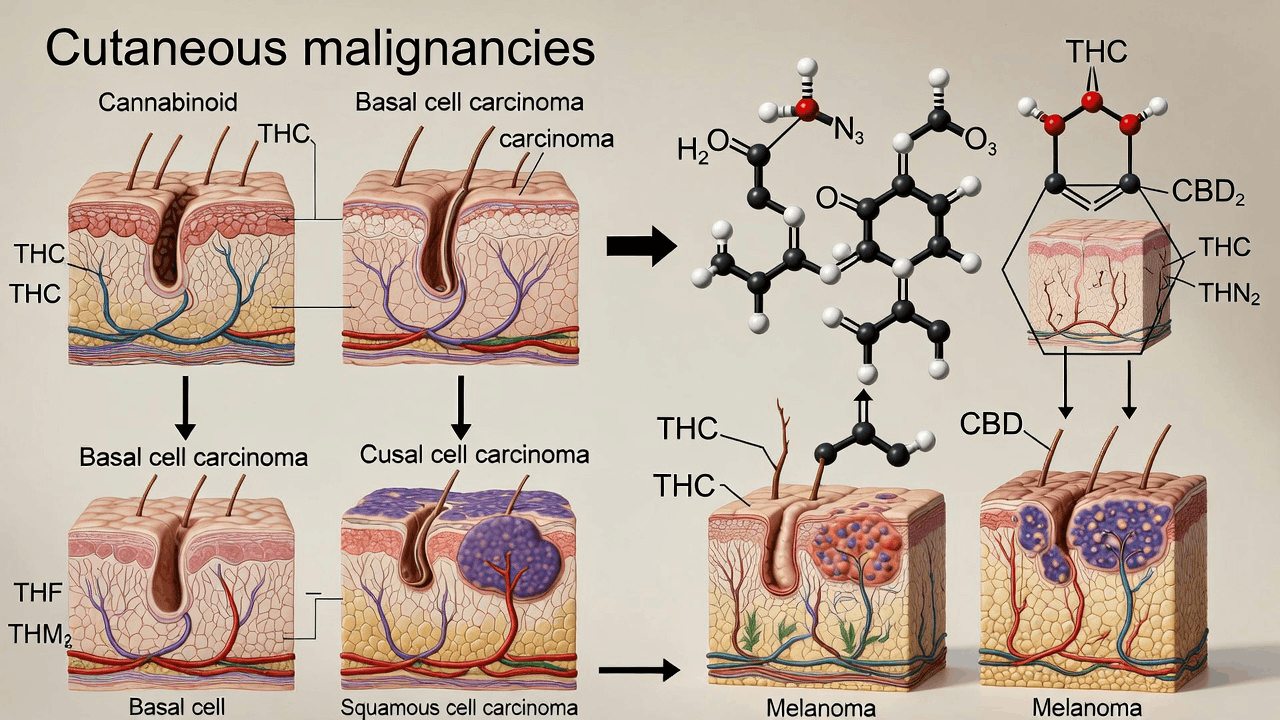
Skin cancer presents one of the most significant and growing challenges in global oncology. According to GLOBOCAN 2022 data, non-melanoma skin cancer (NMSC), encompassing basal cell carcinoma (BCC) and squamous cell carcinoma (SCC), ranks fifth among all cancers worldwide, with over 1.2 million new diagnoses annually.[^4] Melanoma is considerably less common, accounting for roughly 331,000 new cases per year,[^4] but carries an outsized mortality burden: representing only about 5.5% of skin cancer diagnoses, it is responsible for more than 80% of skin cancer deaths.[^10] Immune checkpoint inhibitors (ICIs) such as pembrolizumab and nivolumab have reshaped outcomes for a meaningful subset of advanced melanoma patients. Yet treatment resistance, recurrence, and persistent gaps in effective options, particularly for patients with BRAF-wildtype tumors or ICI-refractory disease, continue to drive the search for novel therapeutic strategies.
That search has increasingly turned toward the endocannabinoid system (ECS): a cell-signaling network with well-established roles in regulating cell proliferation, apoptosis, inflammation, and immune function, all of which are directly relevant to tumor biology. Both CB1 and CB2 cannabinoid receptors are expressed in human skin and skin tumors, and the ECS plays a documented role in epidermal homeostasis, suggesting that cannabinoids may interact with skin cancer biology through pharmacological pathways that extend beyond simple cytotoxicity. In 2025, a widely circulated post on X claimed that applying cannabis mixed with coconut oil to the skin kills cancer cells, drawing tens of thousands of engagements. The enthusiasm is understandable, and not entirely without basis — cannabinoids do have a real and expanding scientific literature behind them in oncology. But the excitement has outpaced the evidence, and that gap is precisely why rigorous investigation matters. This article traces the arc of cannabinoid research in skin cancer: what the science has established, where it gets complicated, and why the emerging picture provides genuine grounds for cautious optimism.
Fast Facts
- Non-melanoma skin cancers (BCC and SCC) rank fifth among all cancers globally, with over 1.2 million new diagnoses annually.[^4]
- Melanoma accounts for roughly 5.5% of skin cancer diagnoses but is responsible for more than 80% of all skin cancer deaths.[^10]
- CB1 and CB2 cannabinoid receptors are expressed in human skin tumors — including BCC, SCC, and melanoma, establishing a biological rationale for endocannabinoid system research in skin cancer.[^1]
- Casanova et al. (2003) demonstrated in the Journal of Clinical Investigation that cannabinoid receptor agonists significantly reduced NMSC tumor size and vascularity in mouse models in vivo.[^1]
- Armstrong et al. (2015) showed that THC induces autophagy-dependent apoptosis across multiple melanoma cell lines and inhibited xenograft tumor growth in a BRAF-wildtype model in vivo.[^2]
- A 2026 study in Phytomedicine identified a novel CBD-driven epigenetic mechanism via a PPARγ–TET1 complex that demethylates the tumor suppressor LRSAM1, operating entirely independently of cannabinoid receptor signaling.[^3]
- As of 2026, no randomized controlled trials evaluating cannabinoid efficacy specifically against melanoma or NMSC have been completed.[^4]
RSO, Public Interest, and the Science Worth Pursuing
The conversation about cannabis and skin cancer is, in many ways, inseparable from the story of Rick Simpson. In 2003, Simpson, a Canadian engineer and cannabis advocate, reported applying a high-THC cannabis extract to basal cell carcinoma lesions on his skin and claiming the lesions resolved within days. What became known as Rick Simpson Oil, or RSO, subsequently spread through websites, an online documentary translated into 72 languages, and a global network of patient testimonials, making it one of the most widely discussed alternative remedies in oncology-adjacent spaces.
The emotional resonance of that narrative is easy to understand. Patients facing a skin cancer diagnosis, and especially those with limited conventional options, will search for any possible avenue. That instinct is human and worth acknowledging. At the same time, a consistent body of peer-reviewed evidence documents the significant gap between the RSO story and what controlled research has actually established. Mamo and colleagues analyzed the ten most-viewed YouTube videos on THC oil and skin cancer in a 2021 study in JMIR Dermatology, finding that all ten were rated as misleading by independent evaluators using validated criteria, and none met the threshold for scientific accuracy.[^6] The authors noted that the volume of inaccurate health content on popular platforms carries real clinical consequences for patients who might delay or forgo evidence-based treatment as a result. These findings are not a reason to dismiss the underlying science. They are, if anything, a compelling argument for pursuing that science more rigorously and communicating it more clearly.
The coconut oil element of the viral X post is worth examining closely, because it illustrates how legitimate pharmacology can travel well beyond what the data truly supports. Cannabinoids are highly lipophilic molecules. Administered orally without a lipid vehicle, they undergo extensive first-pass hepatic metabolism, limiting bioavailability to under 10%. Zgair and colleagues demonstrated in a 2016 study in the American Journal of Translational Research that co-administering oral cannabis with dietary fats increased systemic exposure to both THC and CBD by approximately 2.5- to 3-fold in rat models, driven largely by enhanced intestinal lymphatic transport.[^7] This finding is real and pharmacologically significant, it directly informs the lipid nanocarrier-based delivery systems now being developed for topical skin cancer applications. The lipid-cannabinoid relationship is legitimate science. What it does not support is the claim that applying a cannabis-coconut oil mixture to the skin surface produces meaningful antitumor effects. The mechanisms that enhance oral bioavailability through lipid co-digestion are not the same as those governing topical dermal penetration, and that distinction is precisely the kind of question controlled research is designed to address.
What Preclinical Research Has Established
The preclinical literature on cannabinoids and skin cancer has grown substantially over the past two decades, and the picture it presents is one of genuine mechanistic breadth. Cannabinoids appear to engage multiple oncogenic pathways through both receptor-dependent and receptor-independent mechanisms, a pharmacological profile that, in other therapeutic contexts, would be considered a strong rationale for clinical investigation.
The field's foundational study remains Casanova and colleagues' 2003 paper in the Journal of Clinical Investigation.[^1] Using the CB1/CB2 agonist WIN-55,212-2 and the selective CB2 agonist JWH-133, the authors demonstrated apoptosis in NMSC cell lines in vitro and significantly reduced tumor growth and vascularization in mouse models in vivo. The antitumor effects correlated with impaired epidermal growth factor receptor (EGFR) signaling and markedly suppressed expression of proangiogenic factors — including VEGF, PIGF, and Ang2. Morphometric analyses confirmed a statistically significant decrease in blood vessel size and total vascular area in cannabinoid-treated tumors relative to controls, a finding with obvious relevance to angiogenesis-dependent tumor progression. Critically, CB1 and CB2 receptor expression was confirmed across both mouse and human skin tumors, including BCC and SCC, establishing the receptor-level rationale that subsequent research has consistently extended. The selectivity of the effect, cannabinoids inducing apoptosis in tumorigenic but not non-transformed epidermal cell lines, added an important layer of translational plausibility.
In melanoma, Armstrong and colleagues published a 2015 study in the Journal of Investigative Dermatology demonstrating that THC induces autophagy-dependent apoptosis across multiple melanoma cell lines, CHL-1, A375, and SK-MEL-28, through a mechanism requiring Atg7 but independent of Beclin-1 and Ambra1.[^2] This non-canonical autophagy pathway is distinct from what had been observed in glioma, suggesting that cannabinoids engage cell-type-specific apoptotic machinery in melanoma. Notably, normal human melanocytes at the same concentrations showed resistance to THC-induced cell death, pointing toward a degree of tumor selectivity with potential safety implications for clinical application. In vivo, a Sativex-like preparation (1:1 THC:CBD) significantly inhibited CHL-1 xenograft tumor growth in BRAF-wildtype mice, performing favorably relative to standard-of-care temozolomide. For a tumor subtype lacking targeted therapies, this is precisely the kind of preclinical signal that justifies translational investment.
Understanding the Complexity: Why Careful Research Matters
The preclinical record makes a compelling case for continued investment in cannabinoid research for skin cancer. It also raises important questions that underscore why clinical investigation, designed with precision and attentive to both efficacy and safety, is the essential next step.
Carpi and colleagues' 2017 study in Toxicology in Vitro examined CB1 receptor function in A375 human melanoma cells and found something that cuts against the dominant antitumor narrative: CB1 activity in this model appeared to support, rather than suppress, melanoma cell cycle progression, viability, and migration via Akt/ERK signaling.[^9] The authors characterized this as a tumor-promoting role for CB1 in the A375 context. This should not be read as a refutation of the broader preclinical literature, Casanova's 2003 demonstration of antitumor activity through a CB2-selective agonist is not in conflict with CB1 behaving differently in a specific cell line. What the Carpi data does establish is that receptor specificity matters profoundly, and that context, cell type, receptor subtype, ligand concentration, shapes outcome. Unlocking the therapeutic potential of cannabinoids in skin cancer will require compound-specific, context-aware investigation rather than broad, undifferentiated cannabinoid exposure. That is an argument for more sophisticated research, not for abandoning the hypothesis.
A note on scientific transparency is also warranted. In January 2025, the FASEB Journal published an Expression of Concern regarding Blázquez et al.'s 2006 study "Cannabinoid Receptors as Novel Targets for the Treatment of Melanoma," after a third-party report identified image irregularities in Figure 1A.[^8] The authors acknowledged the compilation error, but original raw data was no longer available for verification. Importantly, they noted that their core finding, CB1 and CB2 receptor expression in melanoma cells, has since been independently confirmed by multiple research groups through distinct experimental approaches, a claim broadly supported by the subsequent literature. The expression of concern illustrates the self-correcting mechanisms of the scientific process at work. Going forward, citations of the 2006 paper should carry appropriate qualification, while recognizing that its central observations remain well-supported.
The most clinically consequential open question concerns the intersection of cannabinoids and immune checkpoint inhibitor therapy. Vigano and colleagues' 2025 review in Frontiers in Immunology examined observational data from cannabis-using patients receiving ICI-based cancer treatment, including melanoma patients.[^5] The central concern is mechanistic: the ECS, particularly through CB2 receptor signaling, can dampen T cell effector function and promote immunosuppressive regulatory T cell (Treg) activity, precisely the immune brake that ICIs such as pembrolizumab and nivolumab are designed to release. Vigano et al. propose that CB2 should be considered an inhibitory immune checkpoint, noting that cannabinoids may effectively re-engage suppressive immune signaling at the same time ICI therapy is working to disengage it. Several observational studies reviewed found no improvement in overall survival or progression-free survival in cannabis-using ICI patients, with some analyses suggesting adverse effects on clinical outcomes. These findings are preliminary and observational rather than causal, but they are clinically significant enough to warrant rigorous prospective evaluation, particularly in melanoma, where ICI therapy is now a frontline standard of care.
The same review, however, charts a forward path. CBD and CBG, both low in CB2 agonism relative to THC, may be better suited for concurrent use in ICI-treated patients. This compound-specific distinction is precisely the kind of mechanistic question that well-designed clinical trials can resolve. The complexity here is real. It is also, fundamentally, tractable.
The Clinical Evidence Gap and the Path Forward
For all the strength of the preclinical rationale, translation to clinical evidence in skin cancer specifically has not yet occurred. Pareek et al.'s 2026 review confirmed that no randomized controlled trials evaluating cannabinoid efficacy specifically against melanoma or NMSC have been completed to date.[^4] One active registered trial, NCT05520294, is examining cannabinoid effects on tumor-infiltrating lymphocytes (TILs) in malignant melanoma, aiming to characterize how cannabinoid use modulates TIL composition and peripheral T-cell activation within the tumor microenvironment. The study is underway but not yet reporting results. Its findings will be important for the immunological questions Vigano et al. raised, and they represent the kind of mechanistically grounded early-phase work the field genuinely needs.
The structural obstacles to completed RCTs in this space are well characterized: substantial variability in cannabinoid preparations across study sites, undefined therapeutic dosing windows for antitumor versus palliative applications, and the immunological complexity introduced by concurrent ICI use. None of these is insurmountable. Pharmaceutical-grade standardized preparations with validated cannabinoid and terpene profiles are increasingly available through both academic and industry channels. Trial designs that stratify by ICI status, incorporate TIL and peripheral immune biomarker endpoints, and explicitly distinguish between CB1-agonist, CB2-agonist, and receptor-independent agents such as CBD are methodologically within reach. Dosing studies that establish pharmacokinetic profiles for antitumor concentrations, distinct from those established for pain or antiemetic indications, are a clear and achievable first step. The nanocarrier formulations already in development for topical NMSC delivery provide an additional path toward localized, high-concentration delivery that sidesteps some of the systemic immunological concerns raised by oral or inhaled cannabinoid use. The scientific framework for meaningful clinical investigation in skin cancer essentially exists. What the field requires now is the sustained institutional, regulatory, and financial commitment to execute it.
Conclusion: A Field Worth Watching and Worth Funding
The claim that applying cannabis mixed with coconut oil to skin cures cancer is not supported by evidence. But the science behind why that claim resonates is real, is growing, and is becoming progressively more sophisticated.
More than two decades of preclinical investigation, conducted across independent research groups and published in leading peer-reviewed journals, has produced a convergent body of findings. Cannabinoid receptor agonists suppress skin tumor growth and angiogenesis in living animal models.[^1] THC activates autophagy-mediated apoptosis in multiple melanoma cell lines and inhibits xenograft tumor growth in BRAF-wildtype models, a subtype with significant unmet clinical need.[^2] CBD engages a novel epigenetic pathway, through PPARγ–TET1-mediated demethylation of the tumor suppressor LRSAM1, that operates entirely independently of cannabinoid receptor signaling.[^3] And pharmaceutical formulation advances, including lipid nanocarrier delivery systems combining cannabinoids with established chemotherapeutics, are beginning to bridge the gap between laboratory findings and deliverable therapeutics.[^4]
Taken together, these findings do not prove that cannabinoids can treat skin cancer in humans. What they do establish, clearly, and across independent lines of evidence, is that the biological rationale is sound, the mechanistic diversity is substantial, and the science is moving in an encouraging direction. The field is also benefiting from a growing pharmaceutical infrastructure: lipid nanocarrier formulations, topical delivery platforms, and compound-specific preparations are removing some of the practical barriers that have historically complicated cannabinoid research. The distance between the current evidence base and clinical validation is not a measure of scientific implausibility. It is a measure of the work that still needs to be done; well-designed, compound-specific, adequately powered clinical trials in defined skin cancer populations, with careful attention to immunological context and transparent reporting of outcomes.
The endocannabinoid system is a real and consequential pharmacological target in skin cancer biology. The public enthusiasm surrounding cannabis and oncology reflects a genuine intuition about a plant that has consistently surprised medicine with the reach of its therapeutic applications. The appropriate response is neither uncritical validation nor reflexive dismissal. It is the rigorous, evidence-driven investigation that the preclinical literature has now earned, and which this field is ready to pursue.
Frequently Asked Questions
Can cannabis cure skin cancer? No. Preclinical research demonstrates that cannabinoids can reduce tumor growth, trigger apoptosis in melanoma cell lines, and engage cancer-relevant biological pathways in laboratory and animal models. However, none of these effects have been confirmed in human clinical trials. Cannabis is not an approved treatment for any form of skin cancer, and no published clinical evidence supports its use as a curative or primary anti-tumor therapy.
Is Rick Simpson Oil (RSO) proven to treat basal cell carcinoma? No. The origin of RSO traces to a 2003 self-report, an uncontrolled, unverified personal account with no pathological confirmation or clinical follow-up. While certain cannabinoid compounds have shown antitumor activity in preclinical models, the gap between laboratory findings and topical home-remedy use has no established pharmacological basis. Patients with BCC should consult a dermatologist for evidence-based treatment options.
If I'm receiving immunotherapy for melanoma, is it safe to use cannabis? This is an unresolved clinical question that should be discussed directly with your oncologist. Emerging evidence reviewed by Vigano et al. (2025) suggests that cannabinoids with high CB2 receptor activity, particularly THC, may reduce the effectiveness of immune checkpoint inhibitors such as pembrolizumab by dampening T cell function. Cannabinoids with lower CB2 agonism, such as CBD and CBG, may carry less immunological risk, but this has not yet been confirmed in controlled clinical trials.[^5]
Further Reading
To explore how cannabis interacts with skin biology and the broader endocannabinoid system, the following resources from the Hytiva Learning Center provide accessible background directly relevant to the science covered in this article:
- Cannabis and the Integumentary System An overview of how cannabinoids interact with skin cells, CB2 receptors in the epidermis, and what the presence of those receptors means for topical cannabinoid applications in dermatology.
- About Cannabis Topicals: What They're Used For and How They Work
A primer on topical cannabinoid delivery, mechanisms of skin absorption, and the conditions for which topical cannabis products are currently being explored.