Cannabinoid Hyperemesis Syndrome
Last Updated
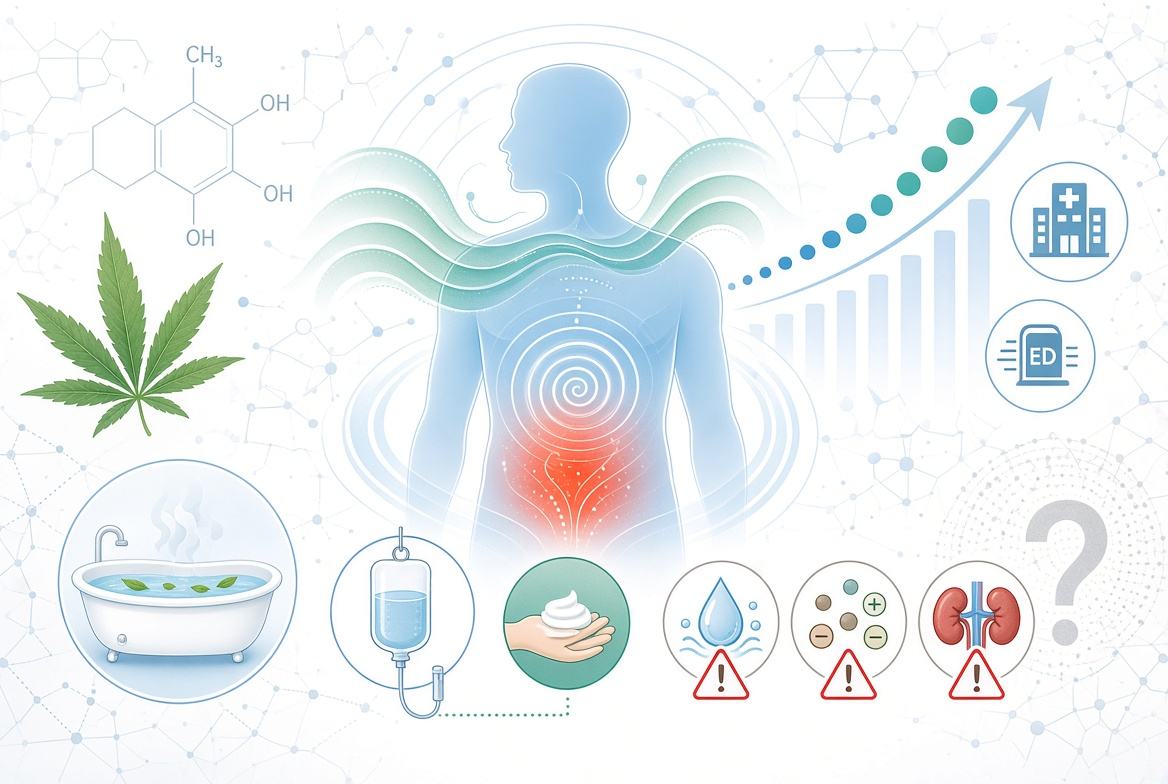
This article reviews clinical picture & diagnostics, prevalence, ED trends/coding, exposures & products, mechanisms, acute ED treatment, cessation & long-term management, complications/safety.
Introduction
Cannabis has documented antiemetic properties, and cannabinoid pharmaceuticals are used for chemotherapy-induced nausea and vomiting [7]. Cannabinoid hyperemesis syndrome sits at the opposite end of that pharmacology. In some people who use cannabis frequently for years, episodes of intense nausea, repeated vomiting, and abdominal pain recur in cycles, often with a compulsion to take hot showers or baths for relief [1, 18]. Allen and colleagues first described the syndrome in 2004 in a South Australian case series [1].
The clinical burden is substantial. CHS is frequently misdiagnosed, which leads to extensive investigation and delayed treatment [19], and one review estimates the average interval from onset of episodes to diagnosis at three to six years [20]. Many patients doubt that cannabis, which some use to control nausea, could be causing their symptoms [7].
This article examines what the evidence shows about diagnosis, frequency, mechanisms, and treatment, and why sustained cessation remains the cornerstone of management.
Clinical Picture and Diagnostic Criteria
The syndrome follows a cyclic pattern. Episodes of nausea, vomiting, and abdominal pain alternate with asymptomatic or minimally symptomatic periods [20]. In a Mayo Clinic series of 98 patients, all were younger than 50, 86% reported abdominal pain, and 52 of the 57 whose response to hot water was documented (91%) reported relief from hot showers or baths [2]. Routine tests are usually unrevealing. In a six-year audit of a Melbourne ED, lipase was normal, imaging was largely normal, and leukocytosis with neutrophilia was common (75.8%) [21].
Rome IV classifies CHS among the nausea and vomiting disorders, with chronic nausea and vomiting syndrome and CVS, and defines it by three features: stereotypical episodic vomiting resembling CVS in onset, duration, and frequency; presentation after prolonged, excessive cannabis use; and relief of vomiting episodes by sustained cessation of cannabis use. Prolonged hot bathing is listed as a supportive feature, and criteria must be met for the last three months with onset at least six months before diagnosis [3, 22]. The framework leaves two gaps: it does not define excessive use, and it does not specify how long abstinence must last before resolution can be judged. Venkatesan and colleagues proposed revised criteria requiring three or more episodes a year, cannabis use more than four times a week for over a year before onset, and resolution after abstinence of at least six months or three typical cycles [3]. The American Gastroenterological Association's 2024 clinical practice update adopted similar criteria [23].
Applying Rome IV to the published literature exposed how thin the case base is. Of 376 patients in case series and case reports, only 71 had at least four weeks of follow-up, and 59, or 15.7% of the total, could be confirmed to meet the criteria [3]. Bathing behavior has also lost its status as a hallmark. It is reported by most patients with CHS and by about half of patients with CVS [7], and the Melbourne audit documented relief from hot showers in only 11.2% of presentations, possibly reflecting incomplete documentation [21]. Whether CHS is a distinct disorder or a cannabis-associated subset of CVS remains open. Venkatesan and colleagues treat it as a possible subset [3], while Russo and Whiteley argue that the two differ in presentation and pathophysiology [24].
Prevalence Estimates
Estimates of how common CHS is depend on the definition. In a New York public hospital ED, Habboushe and colleagues surveyed adults aged 18 to 49 who smoked cannabis at least 20 days a month; 32.9% of 155 eligible respondents (95% CI 25.5–40.3%) met a definition built largely on hot-shower relief of nausea and vomiting, and the authors extrapolated that 2.75 million Americans might be affected each year [25]. Because that definition rests on a nonspecific feature, the estimate likely includes people with other causes of vomiting [3].
A 2023 national survey of 10,255 US respondents aged 16 to 65 who used cannabis in the past year found that 5.98% reported past-year CHS [26]. Participants came from a non-probability online panel, and CHS was defined by a single self-report question about repeated, severe vomiting from marijuana use, which cannot distinguish CHS from CVS or acute overconsumption. Other authors characterize CHS as probably rare [19]. Its true frequency among heavy users is unknown.
Emergency Department Trends and Coding
Using the Nationwide Emergency Department Sample, Swartz and Franceschini defined CHS as a primary vomiting diagnosis with a cannabis-specific secondary code [4]. That proxy rose from 4.4 per 100,000 ED visits in 2016 to a peak of 33.1 in the second quarter of 2020 and stood at 22.3 in 2022, while CVS coded without cannabis fell from 300 to 186 per 100,000. Rates were stable through 2019, CHS-coded visits clustered in young adults (mean age 30.6), and repeat visits could inflate the totals. The authors suggest the post-2020 rise may reflect both increased exposure and increased diagnostic vigilance.
CDC surveillance shows how strongly coding can move these numbers. Across 3,636 EDs with consistent reporting, CHS-involved visits were mostly steady from January 2023 through September 2025 (3.35 per 10,000 in September 2025), rose to 11.26 per 10,000 in October 2025 after a CHS-specific ICD-10-CM code (R11.16) took effect, and averaged 3.7 times the earlier level over the next eight months [6]. The authors note that the abrupt increase might partly reflect improved recognition and coding instead of a true rise in incidence.
In Ontario, CHS ED visits rose 13-fold, from 0.26 to 3.43 per 100,000 population, between January 2014 and June 2021 [5]. Interrupted time-series analysis found no immediate or gradual change in rates at legalization in October 2018, when product and retail access were restricted. Commercialization in March 2020, which coincided with the COVID-19 pandemic, was associated with an immediate 49% increase (incidence rate ratio 1.49; 95% CI 1.31–1.70). In Nevada, CHS-coded ED visits rose from 1.07 to 2.22 per 100,000 between the periods before and after recreational sales began in the third quarter of 2017 [27]. That study combined cannabis-use and vomiting codes, did not specify the denominator for its rates, and detected a significant trend change only from the fourth quarter of 2017.
Ontario and Nevada show more CHS-coded presentations after commercialization, the US national series shows a rise concentrated in 2020 and 2021, and the national survey found no association between state legal status and self-reported CHS [26]. None of these designs can separate exposure from recognition and coding, and none establishes that legalization caused the increase.
Exposure Patterns and the Products Involved
Clinical series describe CHS after years of frequent use. Most patients have used cannabis daily or near-daily for more than two years [7], and in the case series reviewed by Venkatesan and colleagues, mean duration of use was 6.6 years and 68% used daily [3]. Early reviews found a male predominance (72.9% of reported cases) [18], whereas women accounted for 51.5% of individuals with CHS ED visits in Ontario and 50.8% of CHS-coded US visits [4, 5]. The THC potency of cannabis products has also risen dramatically [7].
The largest patient survey recruited 1,134 people through CHS-focused social media communities in late 2024 [16]. Around the time symptoms began, 96.5% used cannabis at least daily and 45% used it six or more times a day; 65.4% had used cannabis for more than three years before onset. Flower and vape cartridges were the most common products, and vape cartridge use was associated with a shorter time to symptom onset. In the national survey, more frequent use of edibles and concentrates was associated with reporting CHS [26]. Both studies rely on self-report, and neither measured or verified product composition. Synthetic cannabinoid receptor agonists have also been linked to CHS [24].
These data place CHS within the legal market. In the patient survey, 61.9% of respondents bought cannabis from licensed dispensaries, and product source did not change how the syndrome presented [16]. Some patients keep using cannabis because they experience it as antiemetic, and using cannabis to manage nausea or vomiting was associated with reporting CHS [7, 26]. No dispensary product is FDA-approved for CHS; the agency has not approved a marketing application for cannabis to treat any disease or condition, so manufacturers cannot market these products as treatments [17]. Russo and Whiteley have proposed studying non-intoxicating cannabis constituents as CHS treatments [24], but no controlled trial has tested CBD or any other cannabis product for this purpose, and CBD products may contain THC. An analysis of CBD extracts sold online detected THC in 21% [28].
Proposed Mechanisms
The mechanism of CHS is unknown, research on it remains sparse, and the explanations below are hypotheses drawn largely from case reports, preclinical studies, and pharmacologic reasoning [18, 29].
Cannabinoids have a biphasic effect on emesis: low doses are antiemetic, and high doses can provoke vomiting [29]. The leading hypothesis holds that prolonged, high-dose THC exposure changes the endocannabinoid system through the CB1 receptor, dysregulating stress responses, thermoregulation, transient receptor potential vanilloid 1 (TRPV1) signaling, and several neurotransmitter systems [29]. Because TRPV1 is a heat-sensitive receptor, this model offers one explanation for relief with hot water and for the rationale behind topical capsaicin, a TRPV1 agonist. Venkatesan and colleagues raise the possibility that chronic use unmasks or triggers a CVS-like disorder in predisposed individuals, and note that THC delays gastric emptying [3]. Richards proposed that episodes are precipitated by stress or fasting in chronic users with abnormal hypothalamic-pituitary-adrenal axis feedback and sympathetic responses [12].
Genetic susceptibility has drawn the most public attention and has the least evidence. Russo and colleagues recruited participants through an online questionnaire; of 99 people in the CHS pool who agreed to testing, 28 returned kits, and 12 controls completed testing [11]. Cases more often carried variants in five genes, including TRPV1 (odds ratio 5.8; 95% CI 1.2–28.4) and the dopamine D2 receptor gene, with P values from 0.012 to 0.043 and no reported correction for multiple comparisons. The hypothesized CB1 receptor gene variant was not significant. Three authors held positions at Endocanna Health, the lead author was an uncompensated adviser to the company, the company co-funded the study, and a patent application on the genomic test battery had been submitted [11]. Industry ties do not make a finding false, but a sample this small, recruited this way and never independently replicated, leaves genetic susceptibility a hypothesis. No genetic test has been validated to predict who will develop CHS.
Acute Treatment in the Emergency Department
Acute care is supportive, centered on intravenous fluids, electrolyte correction, and antiemetics, and treatment failure with standard antiemetics is common [12, 18]. A systematic review of 63 published cases more often reported relief with capsaicin, antipsychotics, or benzodiazepines than with promethazine, ondansetron, or metoclopramide, which is case-level evidence only [30]. Controlled evidence comes from two small trials.
HaVOC, a triple-blind Canadian trial, randomized cannabis users with active vomiting to intravenous haloperidol (0.05 or 0.1 mg/kg) or ondansetron 8 mg [8]. Among 30 treated patients, haloperidol produced a 2.3-cm greater reduction in combined abdominal pain and nausea on 10-cm visual analog scales at two hours (95% CI 0.6–4.0) and shorter time to ED departure (3.1 vs 5.6 hours). Rescue antiemetic use was lower with haloperidol (31% vs 59%), a difference that was not statistically significant. Two patients returned with acute dystonia, both after the higher dose.
The second trial, a double-blind pilot, randomized 30 patients to 0.1% capsaicin cream or placebo applied to the abdomen [9]. Nausea at 30 minutes, the primary endpoint, did not differ significantly between groups. At 60 minutes it was lower with capsaicin (3.2 vs 6.4 cm), and 29.4% of capsaicin patients reported complete resolution of nausea compared with none on placebo. One patient could not tolerate the cream because of skin irritation. With a negative primary endpoint, the 60-minute findings are exploratory.
Nonrandomized data add a signal for droperidol. In a retrospective study of 211 encounters among 158 patients at two Atlanta EDs, droperidol (median dose 1.25 mg) was associated with shorter length of stay (409 vs 641 minutes; adjusted mean ratio 0.76) and lower odds of opioid administration [31]. In an open-label, single-arm study, 47 patients given intravenous droperidol 2.5 mg plus diphenhydramine 25 mg reported mean nausea and vomiting scores falling from 8.3 to 1.4 (0-to-10 scale) within two hours, and 6 (12.8%) returned to the ED within seven days [32]. Because diphenhydramine is itself antiemetic, the authors note that the effect cannot be attributed to droperidol alone. Neither design can separate drug effect from confounding, expectation, or spontaneous improvement.
A 2024 systematic review identified seven studies with 492 patients: evidence for capsaicin was mixed, both dopamine antagonist studies showed benefit, and risk of bias was substantial [33]. The Society for Academic Emergency Medicine's GRACE-4 guideline accordingly makes conditional recommendations for haloperidol or droperidol, and for offering topical capsaicin, in addition to usual care, each based on very low certainty evidence [10]. An earlier systematic review listed avoidance of narcotic medications among supportive measures [18].
Cessation and Long-Term Management
Sustained abstinence is the only intervention consistently associated with lasting resolution [7, 18, 29]. The supporting evidence is consistent but methodologically weak.
In Allen's original series, cyclical vomiting stopped in seven patients who stopped using cannabis and continued in three who did not; three patients who resumed use after a period of abstinence relapsed, and two of them recovered after abstaining again [1]. In the Mayo series, follow-up was available for only 10 of 98 patients; 7 stopped using cannabis, and 6 of those 7 reported complete resolution [2]. A GRADE-based systematic review of 183 articles found resolution after cessation reported in 96.8% of cases [18].
Three problems temper these figures. Resolution with abstinence is part of the case definition, so case collections partly select for it. Follow-up is usually short, as the Rome IV analysis showed [3]. And CVS itself can remit spontaneously, so improvement during abstinence does not by itself establish causation [3]. In a specialty clinic cohort of 140 patients with CVS, 41% used cannabis, yet only 1 of 50 users who reported abstaining for more than a month described resolution, and only 1 patient met Rome IV criteria for CHS [34]. One month may be too short a test, which is why the revised criteria require six months or three cycles [3]. These findings caution against assuming that every cannabis-using patient with cyclic vomiting has CHS.
Stopping is difficult for many patients. Hasler and colleagues identify patient skepticism that cannabis causes the symptoms, perceived benefits of cannabis, and a lack of other effective therapies as barriers [7]. Venkatesan and colleagues recommend multidisciplinary care and offering standard CVS prophylaxis, such as tricyclic antidepressants, alongside advice to abstain [3], a recommendation based on expert opinion and extrapolation from CVS. No study has identified a level of cannabis use that people who have had CHS can safely resume. For the evidence on dependence and withdrawal that shapes this step, see Hytiva's Research article on cannabis use disorder, tolerance, and withdrawal.
Complications and Safety
Repeated vomiting can cause dehydration and electrolyte abnormalities that require ED treatment [12]. In the Melbourne audit, 29 patients re-presented during the six-year study period, most often within three months, and there were no deaths or intensive care admissions [21]. Hospital admission followed 8.8% of CHS ED visits in Ontario and 10.6% of CHS-coded US visits [4, 5].
Acute kidney injury has also been documented. Habboushe and Sedor reported a case, found five earlier case reports of kidney injury among 55 published CHS case reports, and argued that intractable vomiting combined with constant hot showers creates a distinct risk of severe dehydration and prerenal failure [13]. Deaths are rare but documented: a forensic case series reported three deaths in adults aged 27 to 31 with a history of CHS, two of them attributed to the syndrome [14].
Treatment carries its own risks. Haloperidol caused acute dystonia in two HaVOC patients [8]. Droperidol carries a boxed warning for QT prolongation and torsade de pointes; its label reserves the drug for patients who have not responded adequately to other treatments, calls for a 12-lead ECG before administration and ECG monitoring for two to three hours afterward, and lists hypokalemia and hypomagnesemia among the risk factors [35]. Low or low-normal electrolytes were common in the Melbourne audit: potassium was below 4.0 mmol/L in 57.9% of tested presentations (below 3.0 mmol/L in 1.6%), and magnesium was below 0.70 mmol/L in 21.6% of the minority tested [21]. A forensic case report attributed the death of a 22-year-old woman with CHS to torsades de pointes during ED treatment, citing vomiting-induced hypokalemia and QT-prolonging medications (haloperidol and ondansetron were detected), with cardiac gene variants as contributing factors [15]. The CH2O and University of Illinois Chicago trial protocols exclude patients with a prolonged QTc interval [36, 37].
Patients who cannot keep fluids down need prompt evaluation for volume depletion, electrolyte disturbance, and kidney injury. They may also be disbelieved: Swartz and Franceschini note that some clinicians believe these patients exaggerate their symptoms [4].
Future Research Directions
Prospective validation of diagnostic criteria. A prospective cohort that enrolls adults with recurrent vomiting and frequent cannabis use, documents exposure with toxicology, and follows participants through six months of supported abstinence could test which criteria best predict resolution and how often apparent CHS proves to be CVS. Chart-review studies validating the new R11.16 code against clinical criteria would make post-2025 surveillance interpretable [6], a need Swartz and Franceschini also emphasize [4]. The French CANN-AIE cohort, enrolling 3,000 adults with abdominal pain or vomiting in EDs and following regular cannabis users for three months, will add incidence, recurrence, cessation, and addiction-referral data [38].
Product-characterized exposure cohorts. Current product data are self-reported [16, 26]. A prospective cohort of frequent consumers recruited through licensed retail settings could record product type, labeled THC and other cannabinoid content, route, daily THC dose, and frequency, verify composition through certificates of analysis or independent testing in a subsample, and capture new-onset cyclic vomiting through structured follow-up. Such a cohort could estimate incidence and test whether concentrates, vape cartridges, edibles, or total daily THC dose predict onset. Its findings would be associations, open to confounding by overall intensity of use.
Adequately powered treatment trials. The CH2O trial, comparing intramuscular haloperidol 5 mg with olanzapine 10 mg in 31 patients, completed on October 1, 2026, and has not yet posted results [36]; a 20-participant University of Virginia capsaicin trial completed in March 2022 still has none [39]. Publishing both would reduce the risk of selective publication. Multicenter trials comparing droperidol, haloperidol, and capsaicin, with prespecified endpoints (time to oral fluid tolerance, length of stay, return visits) and dystonia, QTc, and electrolyte monitoring, could move recommendations beyond very low certainty. A University of Illinois Chicago study, not yet recruiting, plans to measure one-month ED return rates among patients discharged with an as-needed oral haloperidol prescription [37]. Any study of CBD or other non-intoxicating constituents as treatment belongs in controlled trials using analytically verified, THC-free products [24, 28].
Cessation-support trials. A ClinicalTrials.gov search in October 2026 found no registered trial of a cessation intervention designed for CHS. A pragmatic randomized trial comparing ED-initiated brief intervention and referral with usual care, with biochemically confirmed abstinence and recurrence at 6 and 12 months as outcomes, would address both treatment and diagnostic certainty.
Independent genetic and mechanistic studies. Replication requires larger, prospectively recruited samples of clinically confirmed cases and matched heavy-use controls, prespecified correction for multiple comparisons, and investigators without a financial interest in a test [11]. CB1 receptor imaging in people with CHS, compared with equally heavy users without symptoms during use and after abstinence, could test the receptor-adaptation hypothesis directly.
The Takeaway
CHS is a recognized complication of long-term, frequent THC use that causes recurrent vomiting, repeated ED visits, and occasionally kidney injury or death. CHS-coded ED visits have risen, but changes in recognition and coding account for an unknown share of that rise, and the data do not show that legalization caused it.
The clinical pattern, its association with heavy long-term use, and consistent case-series reports of resolution after sustained abstinence are established. The mechanism, a threshold of use, the relationship to CVS, the role of genetics, and the comparative effectiveness of acute treatments are not. Acute care rests on two small randomized trials and very low certainty evidence, and no cannabis or CBD product has been shown to treat or prevent CHS.
For clinicians, the evidence supports recognizing the pattern early, correcting dehydration and electrolytes, considering haloperidol or droperidol with ECG monitoring and within the limits of droperidol's boxed warning, and placing cessation at the center of long-term care. For the field, the priorities are prospective validation of diagnostic criteria and the new diagnosis code, product-characterized exposure cohorts, publication of completed treatment trials, and randomized studies of the cessation support on which CHS care depends.