Cannabis Use Disorder, Tolerance, and Withdrawal
Last Updated
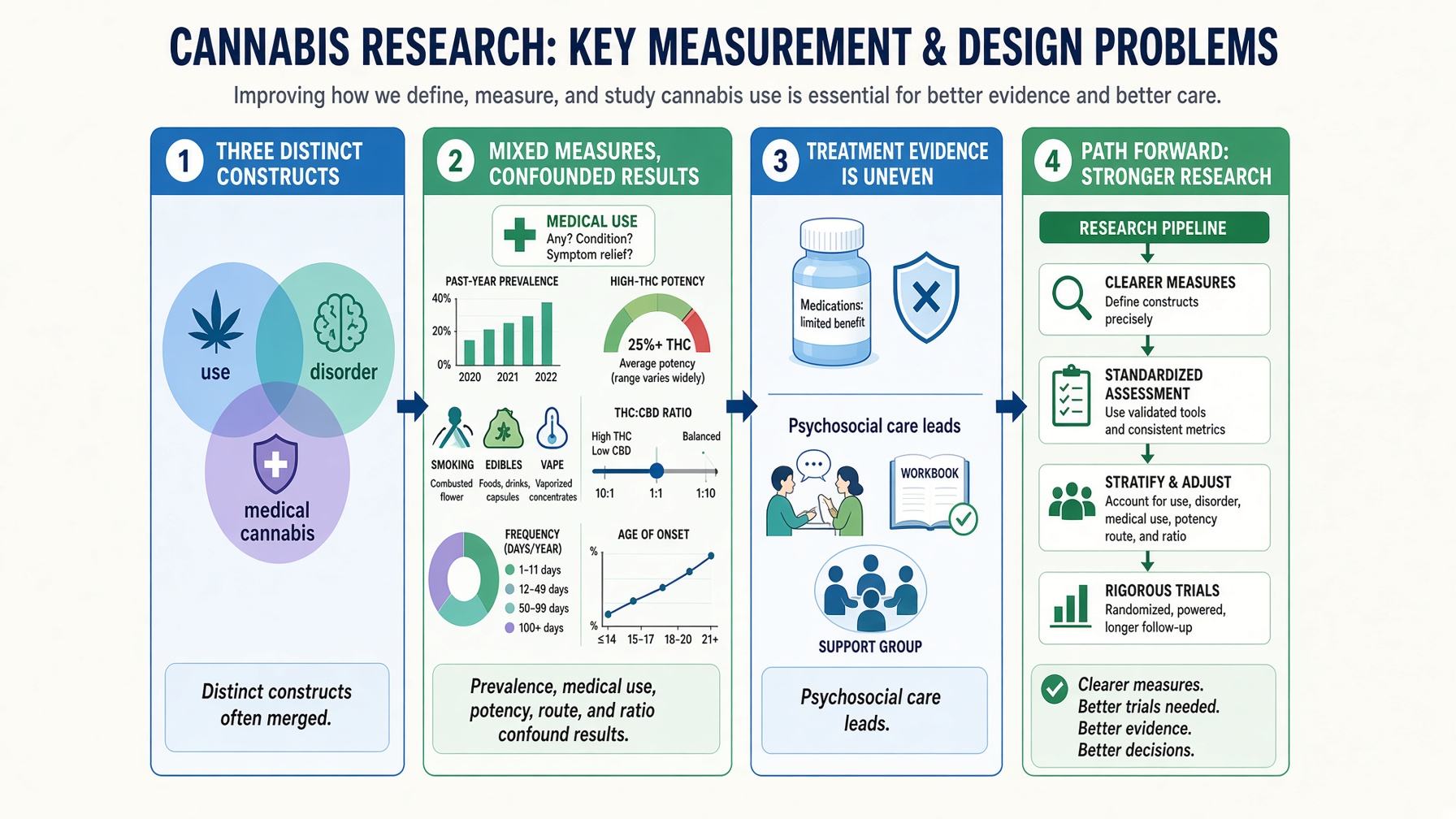
Studies merge use, disorder, and medical cannabis. Prevalence, potency, route, and ratio confound findings. Drugs show little; psychosocial care leads. Takeaway: clearer measures and better trials.
Key Findings
- Pooled across 21 epidemiological studies, 22% of people who have used cannabis meet criteria for a cannabis use disorder (95% CI 18% to 26%). Among young people using weekly or daily, cohort estimates of cannabis dependence rise to 33% (95% CI 22% to 44%). The widely quoted figure of three in ten describes a narrower group than the phrase "people who use cannabis" suggests [1, 2].
- An estimated 20.6 million Americans aged 12 and older met criteria for past-year cannabis use disorder in 2024, up from 16.7 million in 2021. Severity was classified as mild in 54.4% of cases, moderate in 27.9%, and severe in 17.7% [3].
- Cannabis withdrawal is common among people who use regularly, with a pooled prevalence of 47% across 47 studies and 23,518 participants. The estimate is strongly setting-dependent: 17% in population samples, 54% in outpatient samples, and 87% in inpatient samples [4].
- Cortical CB1 receptor downregulation in daily cannabis smokers is measurable, correlates with years of use, and reversed to control levels after roughly four weeks of monitored abstinence in a positron emission tomography study [5].
- Higher-potency cannabis use is associated with greater dependence severity, while lower-potency preparations showed no such association in the same cross-sectional sample. No available design separates potency from the frequency and quantity of use that accompany it [6, 7, 8].
- No medication is approved by the FDA for cannabis use disorder. A 2025 Cochrane review of 37 randomized trials found that abstinence at end of treatment was no more likely with delta-9-tetrahydrocannabinol preparations than placebo (RR 1.04, 95% CI 0.71 to 1.52; moderate-certainty evidence) or with N-acetylcysteine (RR 1.17, 95% CI 0.73 to 1.88; moderate-certainty evidence) [3, 9].
- Cannabis use disorder prevalence among people using cannabis medicinally is 25% (95% CI 18% to 33%) under DSM-5 criteria, comparable to non-medical use. No published evidence establishes whether CBD-dominant or fixed-ratio commercial products alter dependence liability [10].
Cannabis dependence occupies an unusual position in clinical discussion. For decades the question was whether it existed at all, and the answer arrived slowly through controlled abstinence studies, receptor imaging, and eventually a diagnostic category. That question is settled. Regular heavy cannabis use produces measurable neuroadaptation, a reproducible withdrawal syndrome, and in a subset of people a pattern of use that meets criteria for a substance use disorder.
What remains unsettled is narrower and more consequential for clinical practice. The headline statistics that circulate in public health messaging, clinical education, and product marketing rest on different denominators, two different diagnostic systems, and data collected across three decades of a rapidly changing cannabis market. A clinician who quotes "three in ten" and a clinician who quotes "22%" are both citing peer-reviewed sources. They are describing different populations.
This article separates three constructs that the literature and the public conversation routinely merge: pharmacological tolerance, physical dependence expressed as a withdrawal syndrome, and cannabis use disorder as a diagnostic entity. It then examines what the prevalence estimates count, what the potency literature can and cannot establish about causation, and what treatment achieves. Where the evidence does not support a conclusion, the article says so.
Three Constructs the Literature Keeps Merging
Tolerance as Neuroadaptation
Tolerance to cannabis is a receptor-level phenomenon with direct imaging evidence. Positron emission tomography in chronic daily cannabis smokers demonstrated regionally selective downregulation of cortical CB1 receptors, with the magnitude correlating with years of cannabis smoking. After approximately four weeks of continuously monitored abstinence on a secure research unit, receptor density returned to control levels [5].
Two features of that finding deserve attention. The downregulation was confined to cortical regions, and it was reversible. Neither feature is unusual for an agonist acting at an abundant G protein-coupled receptor, and neither by itself indicates a disorder. Tolerance is what the endocannabinoid system does under sustained exogenous agonist exposure. The same adaptation appears in patients taking prescribed cannabinoid medicines for approved indications.
Withdrawal as a Syndrome
Cannabis withdrawal is a defined clinical syndrome and is prevalent among people who use regularly. A systematic review and meta-analysis of 47 observational studies covering 23,518 participants estimated pooled prevalence at 47% (95% CI 41% to 52%), with substantial heterogeneity [4].
The stratified estimates carry more clinical information than the pooled figure. Prevalence was 17% (95% CI 13% to 21%) in population-based samples, 54% (95% CI 48% to 59%) in outpatient samples, and 87% (95% CI 79% to 94%) in inpatient samples, a statistically significant gradient (P < .001). Concurrent tobacco and other substance use disorders and daily cannabis use were each associated with higher withdrawal prevalence [4]. A figure drawn from an inpatient addiction unit describes a population selected for severity and should not be applied to a general-population consumer.
Cannabis Use Disorder as a Diagnosis
DSM-5-TR defines cannabis use disorder as a pattern of use producing clinically significant impairment or distress, established by meeting at least two of eleven criteria within twelve months. Severity thresholds are two to three criteria for mild, four to five for moderate, and six or more for severe [3].
Tolerance and withdrawal are two of those eleven criteria. A person who develops both and meets no other criterion satisfies the diagnostic threshold for mild cannabis use disorder. This is a structural feature of the diagnostic system, not an error in its application, and it has consequences for how prevalence estimates should be read.
What the Prevalence Estimates Actually Count
A systematic review and meta-analysis of 21 epidemiological studies published between 2009 and 2019 estimated that 22% (95% CI 18% to 26%) of people who have used cannabis meet criteria for a cannabis use disorder, with 13% meeting criteria for cannabis abuse and 13% for cannabis dependence. Cohort data raised the estimated risk of cannabis dependence to 33% (95% CI 22% to 44%) among young people using weekly or daily [1].
The frequently cited estimate that approximately three in ten people who use cannabis have cannabis use disorder, which appears on CDC cannabis pages, traces to a specific source: national survey data collected between April 2012 and June 2013, analyzed under DSM-IV criteria, in adults [2, 11]. That analysis reported past-year DSM-IV marijuana use disorder in 30.6% of past-year users, down from 35.6% a decade earlier [2].
The direction of that change deserves emphasis. Past-year cannabis use in adults rose from 4.1% to 9.5% across the two survey waves while past-year use disorder rose from 1.5% to 2.9%. The investigators concluded that the increase in total use disorder prevalence was attributable to the increase in the number of people using, because per-user risk did not rise [2]. That period overlapped substantial increases in product potency [7].
Current national estimates place past-year cannabis use disorder at 7.1% of people aged 12 and older, or 20.6 million, up from 6.0% and 16.7 million in 2021. Prevalence varied by age group, reaching 16.1% in young adults aged 18 to 25 and falling to 1.3% in adults 65 and older. Severity was mild in 54.4% of cases, moderate in 27.9%, and severe in 17.7% [3].
Those figures come from different surveys using different diagnostic systems and different age ranges, so they do not form a clean time series. What they establish jointly is that the population carrying a cannabis use disorder diagnosis is large, growing in absolute terms, and majority mild by the diagnostic system's own severity thresholds.
Medical Use and the Misclassification Problem
A systematic review and meta-analysis of 14 publications covering 3,681 participants across five countries estimated cannabis use disorder prevalence among people using cannabis medicinally at 25% (95% CI 18% to 33%) under DSM-5 criteria across all prevalence periods, and 29% (95% CI 21% to 38%) for use in the past 6 to 12 months. The authors characterized this as comparable to prevalence among people using cannabis non-medically [10].
That finding is uncomfortable for any account of medical cannabis as categorically lower-risk, and it should be reported plainly. It also requires careful interpretation, and a federal advisory published in May 2026 states the interpretive problem directly. People using medical cannabis often report daily or near-daily use, which produces expected neuroadaptation in the form of tolerance and withdrawal within a therapeutic context, and which may be misclassified as cannabis use disorder without careful clinical assessment. The advisory recommends that among patients using medical cannabis, tolerance and withdrawal alone should not be used to diagnose the disorder, and that evaluation should prioritize impaired control, risky use, continued use despite harm, and excessive time spent using or recovering from use [3].
Two criteria satisfied by predictable pharmacology meet the threshold for mild disorder. Since mild cases constitute the majority of diagnosed cases nationally, the size of this measurement problem is not trivial. Neither the medicinal-use meta-analysis nor the national survey estimates were designed to partition diagnoses into those driven by neuroadaptation alone and those reflecting impaired control. The question of how much of the mild-severity stratum represents therapeutic neuroadaptation is open, answerable, and unanswered.
Potency, Exposure, and the Confounding Problem
A cross-sectional survey of UK adults found that frequency of high-potency cannabis use predicted greater severity of cannabis dependence (b = 0.254, 95% CI 0.161 to 0.357, P < .001), and that the association strengthened as age decreased. Frequency of lower-potency preparations showed no association with dependence severity in the same sample [6]. The contrast within a single dataset is informative, and the design is cross-sectional and reliant on self-reported product type.
A systematic review of 20 observational studies, six of which addressed cannabis use disorder, found that use of higher-potency cannabis relative to lower-potency cannabis was associated with increased risk of both psychosis and cannabis use disorder, with evidence varying for depression and anxiety. The authors identified standardization of exposure measures and longitudinal designs as requirements for strengthening the evidence [7]. A scoping review of 71 studies in people aged 14 to 25, searched through October 2025, reached a directionally consistent conclusion, reporting that high-potency use above 15% THC was associated with a greater number and magnitude of adverse mental health outcomes including cannabis dependence [8].
The consistency across these reviews is real, and so is the limitation they share. Potency is not randomly assigned. People who select high-potency products differ from people who do not in frequency of use, quantity consumed, age of initiation, and reasons for use, and the observational designs available cannot isolate potency from that cluster. Compounding this, potency is a concentration and dependence liability plausibly tracks delivered THC dose, which depends on concentration, amount consumed, route, and inhalation behavior together. Whether titration behavior offsets concentration, and to what degree, is unquantified in these datasets.
The honest position is that higher-potency use identifies a higher-risk pattern of use. Whether the concentration itself is causal, or serves as a marker for the exposure pattern that is causal, is unresolved by the current literature.
Route, Formulation, and Cannabinoid Ratio
Route of administration determines onset, intensity, and duration of intoxication, with inhalation producing rapid onset and shorter duration than oral consumption [3]. Whether route materially alters the character or severity of the withdrawal syndrome is a separate question, and the withdrawal literature does not answer it. The meta-analysis establishing withdrawal prevalence stratified its estimates by sample source and examined concurrent substance use and daily use as covariates, without partitioning by route or product format [4].
The cannabinoid-ratio question has a clearer answer, and the answer is that direct evidence is absent. No published study establishes whether CBD-dominant or fixed-ratio commercial cannabis products alter dependence liability relative to THC-dominant products at matched THC exposure. Three adjacent literatures exist and none substitutes for that comparison. Purified CBD has been tested as a treatment for established cannabis use disorder, which is a different question from whether product composition modifies risk of developing it. The high-potency versus low-potency comparisons describe product categories that differ in THC concentration, and they infer CBD content from product type without measuring it [6]. Products containing only non-intoxicating cannabinoids carry low misuse potential, which follows from the absence of intoxication and says nothing about mixed-ratio products [3].
Constructing an argument for ratio-dependent dependence liability from these components would require assumptions none of them supports. The question is tractable and has not been tested.
What Medication Has and Has Not Shown
No medication is approved by the FDA for cannabis use disorder [3]. A Cochrane review updated in 2025, covering 37 randomized trials and 3,201 participants, found that abstinence at end of treatment was no more likely with THC preparations than placebo (RR 1.04, 95% CI 0.71 to 1.52; 4 studies, 290 participants; moderate-certainty evidence) or with N-acetylcysteine (RR 1.17, 95% CI 0.73 to 1.88; 2 studies, 270 participants; moderate-certainty evidence). Cannabidiol produced an estimate too imprecise to interpret (RR 2.23, 95% CI 0.54 to 9.32; 1 study, 68 participants; low-certainty evidence). Anticonvulsants and mood stabilizers were associated with greater withdrawal from treatment due to adverse effects (RR 2.88, 95% CI 1.05 to 7.86; very low-certainty evidence). The review concluded that these pharmacotherapies remain experimental [9].
Agonist approaches have produced findings that are real and narrower than often reported. A 12-week randomized trial of nabiximols in 128 treatment-seeking participants with cannabis dependence met its primary endpoint, with the placebo group reporting 53.1 days of cannabis use over 12 weeks against 35.0 days in the nabiximols group (estimated difference 18.6 days, 95% CI 3.5 to 33.7, P = .02). Treatment retention was similar between groups at 44.8% and 49.2% [12]. A meta-analysis of 54 randomized trials across mental and substance use disorders found that a CBD and THC combination reduced cannabis withdrawal symptoms (SMD -0.29, 95% CI -0.57 to -0.02) and weekly grams of cannabis used (-1.00, 95% CI -1.69 to -0.30) in cannabis use disorder, while reporting higher odds of all-cause adverse events across all indications (OR 1.75, 95% CI 1.25 to 2.46, number needed to harm 7) and concluding that routine cannabinoid use for these conditions is currently rarely justified [13].
Reduced days of use and reduced withdrawal severity are legitimate outcomes. They are not abstinence, and the Cochrane analysis of abstinence specifically returned a null with moderate-certainty evidence.
A phase 2a adaptive Bayesian trial of purified oral cannabidiol in 82 participants identified 400 mg and 800 mg as exceeding prespecified efficacy thresholds against placebo, with 400 mg increasing days of abstinence by 0.48 per week (95% interval 0.15 to 0.82) and reducing urinary THC-COOH to creatinine ratio; the 800 mg estimate for abstinence days crossed zero (0.27, 95% interval -0.09 to 0.64), and 200 mg was eliminated at interim analysis as inefficacious [14]. This is pharmaceutical-grade isolated cannabidiol at doses far above commercial CBD products, tested as a treatment.
Psychosocial Treatment and the Current Pipeline
Psychosocial treatment remains the evidence-supported foundation. A network meta-analysis of 57 studies found that dialectical behavioral and acceptance and commitment therapies reduced use frequency relative to a nonspecific comparator (MD -0.18, 95% credible interval -0.26 to -0.09), as did cognitive behavioral therapy with motivation enhancement combined with contingency management (MD -0.15, 95% credible interval -0.23 to -0.07), both at low certainty. Interventions including contingency management also supported abstinence at very low certainty, while cognitive behavioral therapy with motivation enhancement reduced treatment completion [15].
A phase 3 trial of an investigational agent, PP-01, for mitigation of cannabis withdrawal symptoms began dosing in June 2026 and is recruiting 420 adults aged 18 to 55 with moderate to severe cannabis use disorder across 22 US sites. The design uses 34 days of dosing including a one-week inpatient period, with nabilone as an active comparator and placebo as a third arm. Its co-primary endpoints compare the investigational agent against placebo over days 2 to 7 and against nabilone over days 25 to 35 to assess rebound [16]. The sponsor's earlier phase 2 trial completed in August 2023 and has no results posted to ClinicalTrials.gov and no peer-reviewed publication, so no efficacy finding from that trial can be evaluated here [17].
Future Research Directions
The measurement problems identified above are not intractable, and several are addressable with designs that do not require a drug-development pathway.
Partitioning the mild-severity stratum. The most immediately answerable question is what proportion of mild cannabis use disorder diagnoses rest on tolerance and withdrawal alone. A cross-sectional study administering full DSM-5-TR criteria with criterion-level reporting, stratified by medical versus non-medical use motive and by daily versus non-daily use, would resolve it. Criterion-level data already exist in national survey files and in clinical cohorts; the analysis has simply not been reported in that form.
Separating potency from delivered dose. Advancing the potency question requires exposure characterization that observational surveys do not currently provide. A prospective cohort recruiting from regulated retail, capturing certificate-of-analysis cannabinoid content, purchased quantity, dosing frequency, and route, would permit estimation of delivered THC in milligrams per day, a unit that product concentration alone cannot supply. Modeling dependence severity against delivered dose with concentration entered separately would indicate whether concentration carries independent signal once dose is controlled. This design can establish association and dose-response, and cannot establish causation.
Testing ratio effects directly. The cannabinoid-ratio question requires a comparison that has not been run. A randomized crossover study in adults who already use cannabis regularly, comparing standardized THC-dominant and CBD-containing preparations matched on THC dose, with cannabinoid content analytically verified and with abstinence-induced withdrawal severity measured on a validated instrument, would produce a direct answer. A null result would be informative and should be published as such.
Characterizing withdrawal by route and format. No current dataset partitions withdrawal severity and trajectory by inhaled versus oral use. A prospective observational study following people initiating a cessation attempt, with product format and route recorded at baseline and daily symptom diaries through at least 28 days, would establish whether format matters. The absence of withdrawal-intensity outcomes across the psychosocial trial literature makes this gap larger than it appears.
Improving treatment measurement. The treatment literature reports abstinence and days of use far more consistently than withdrawal severity, which limits comparison against the agent now in phase 3. Trials of psychosocial interventions should incorporate a validated withdrawal measure as a prespecified secondary endpoint. Separately, the contingency management signal warrants a trial powered specifically for abstinence, since current estimates rest on very low-certainty evidence drawn from few studies.
Across all of these, the standardized measurement of cannabis consumption remains the limiting infrastructure. Without a consistent unit of exposure, dose-response claims in this field will continue to rest on product category labels.
The Takeaway
The evidence establishes that regular heavy cannabis use produces reversible CB1 receptor downregulation, that a cannabis withdrawal syndrome is real and common among people who use regularly, and that a substantial minority of people who use cannabis meet diagnostic criteria for a use disorder. It also establishes that no medication has been shown to produce abstinence, with moderate-certainty null findings for the two most-studied classes, and that psychosocial treatment carries the better evidence at low certainty.
The evidence does not establish that rising potency has raised per-user dependence risk. The only national data examining that directly found per-user risk falling slightly while absolute burden rose with the number of people using. It does not establish that concentration is causal independent of the use pattern that accompanies it. It does not establish that CBD-dominant or fixed-ratio products alter dependence liability, because that comparison has not been made. And it leaves unclear how much of the diagnosed population, most of which is classified as mild, reflects impaired control as opposed to the neuroadaptation that predictable daily dosing produces in anyone.
That last uncertainty is the one most available to resolution. It requires no new trial, no new instrument, and no regulatory pathway, only criterion-level reporting of data that has largely already been collected. A field that can say precisely what its central diagnostic statistic counts will be in a stronger position to interpret everything downstream of it, including the potency question, the medical-use question, and the results of the trials now underway.