What a 44-Year Study Says About Cannabis and the Aging Brain
Last Updated
One of the longest studies ever done offers a reassuring answer, and an important limit.
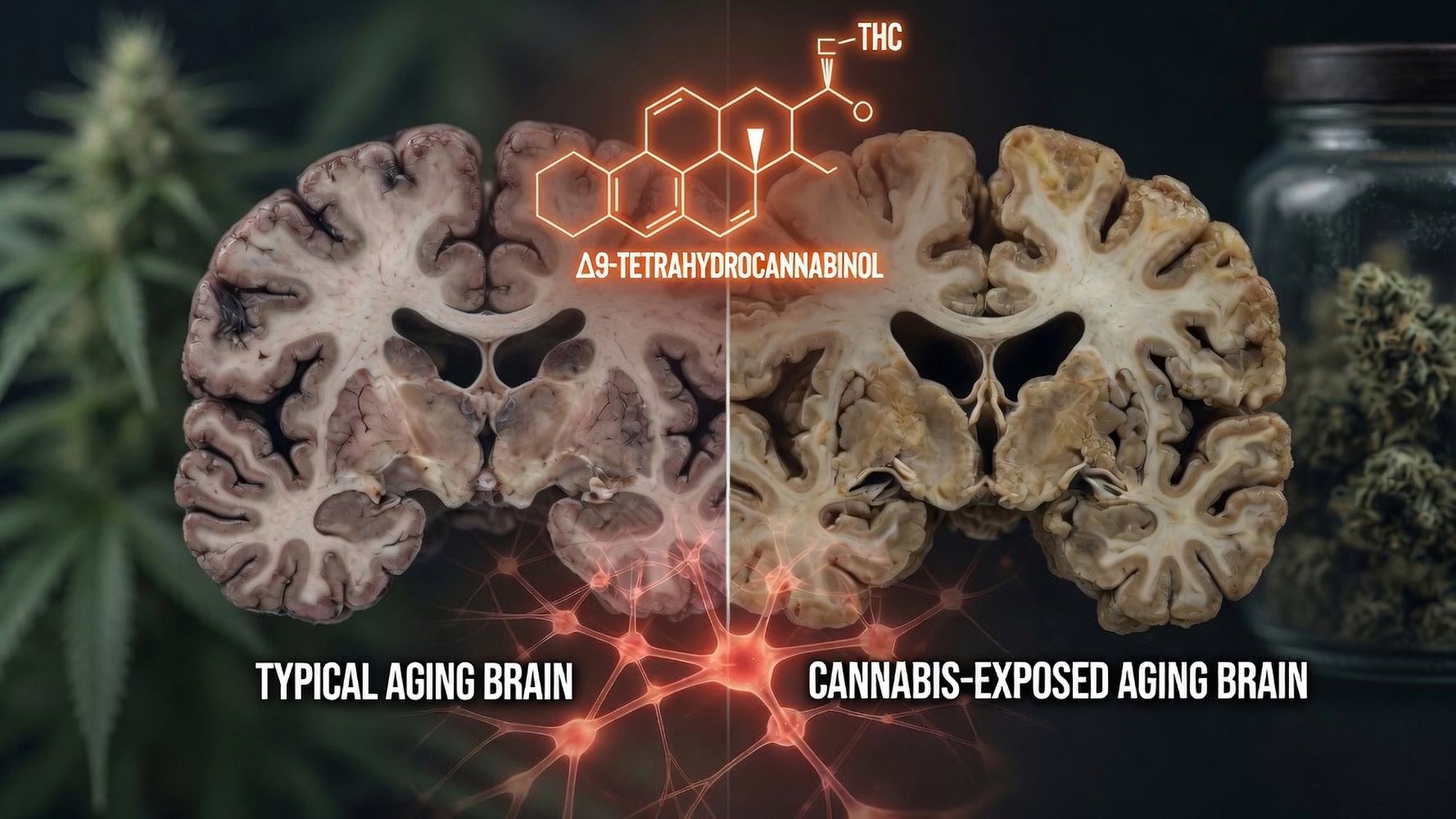

Key Takeaways
- A Danish study followed 5,162 men for an average of 44 years, measuring their cognitive ability around age 20 and again around age 64.
- Men who had used cannabis did not show faster age-related mental decline than men who had never used it.
- They actually declined slightly less, but the difference was very small and most likely reflects other differences between the groups rather than anything cannabis did.
- Most of these men used cannabis as adults and had largely stopped, a pattern different from the heavier, teenage-onset use that other research has linked to lasting effects.
- The study included only men, and the cannabis available decades ago was far weaker than today's products.
Few questions about cannabis attract more confident answers and less reliable evidence than what it does to the brain over a lifetime. Headlines swing between warnings that it permanently dulls the mind and claims that it protects against aging. The truth has been hard to pin down for a simple reason: answering it properly requires testing the same people before they start using and again decades later, and almost no study has managed that. A Danish research team recently did, and the result is worth understanding carefully, because it is both more reassuring and more limited than the headlines it generated.
Why This Study Is Unusual
Most research on cannabis and thinking skills captures a single moment in time, which makes it impossible to separate cause from coincidence. The Danish study, led by Høeg and colleagues and published in 2024, avoided that trap by drawing on a remarkable national resource.[1] For decades, young men in Denmark completed a standardized intelligence test when they reported for military conscription, usually around age 20. Those scores were preserved. The researchers tracked down more than five thousand of these men in late midlife, around age 64, and gave them the very same test again.[1]
That design is the study's real strength. It works like measuring the same plank with the same ruler twice, many years apart. Because the test never changed, the difference between the two scores reflects how each man's thinking actually shifted over time, not a quirk of using different tools. With an average gap of 44 years between the two measurements, this is one of the longest windows anyone has managed to study.[1]
The team then compared the men who reported ever using cannabis with those who had not, adjusting for a long list of other factors that influence cognitive aging, including education, alcohol use, smoking, and mental and physical health.[1]
What They Actually Found
The headline finding is straightforward. Over those 44 years, the men who had used cannabis did not decline faster than the men who had not. If anything, they declined slightly less. On average, the whole group lost about 6 points on the IQ-style scale as they aged, and cannabis users fared slightly better than non-users.[1]
Here is where care matters. That "slightly better" gap was tiny, small enough that the researchers themselves noted it may have no real-world meaning. And the two groups differed in ways that easily explain it. The cannabis users in this group tended to have more education and a somewhat higher starting score, both of which independently track with how well people hold onto their thinking skills as they age.[1] In other words, the small edge almost certainly reflects who these men were, not what cannabis did for them. This is the key thing to take away: the study is good evidence that adult cannabis use was not linked to faster mental decline, but it is not evidence that cannabis protects or improves the aging brain. Reading it that way overstates what this kind of study can show.
The researchers also checked whether starting younger, or using more frequently for more years, made any difference among the users. Neither did, in a statistically meaningful way, though the groups for those comparisons were smaller and harder to draw firm conclusions from.[1]
The Catch: Timing Seems to Matter
The most important context sits in who these men were and how they used cannabis. The large majority had not used it in the year before the follow-up. This was, for the most part, a group describing adult-life use that had largely tapered off, not lifelong heavy use.[1]
That distinction matters because it lines up with a contrasting and frequently cited piece of research. A long-running study in Dunedin, New Zealand, led by Meier and colleagues, followed people from childhood and found something different: those who began using cannabis heavily as teenagers and kept it up showed a measurable drop in IQ, and the decline did not fully recover even after they cut back. The sharpest effects appeared in those who started youngest.[2]
These two studies are easier to reconcile than they first appear. The likely difference is developmental timing. A young, still-developing brain may be more vulnerable to lasting change, the way a bend forced into a sapling can set into the grown tree, while the same pressure applied to mature wood leaves little trace once removed. The Danish men were mostly adults when they used and had largely stopped, and other research suggests cannabis-related effects on thinking often ease after a long period without use. An Australian study by McKetin and colleagues, which followed middle-aged adults, similarly found no link between adult cannabis use and faster cognitive decline, reinforcing the same pattern.[3] The Danish result, then, describes adult-onset, mostly-former use, and should not be stretched to cover heavy use that begins in adolescence.
What This Study Cannot Tell Us
A few limits are worth knowing, because they shape how far the findings travel.
First, only about one in seven of the invited men actually took part, and those who join studies like this tend to be healthier and better educated than those who do not. That can tilt the results toward a rosier picture.[1] Second, the study included only men, and there is reason to think cannabis may affect cognition differently by sex, so these findings should not be assumed to apply to women.[1] Third, the men were recalling decades of past use from memory, which is never perfect. And fourth, the cannabis these men used through the 1960s, 70s, and 80s was far less potent than much of what is sold today, so a clean result for their era does not automatically extend to modern high-strength products.[1]
It is also worth being clear about one tempting leap. Some early research in mice and rats has hinted that compounds related to cannabis might benefit the aging brain, but those are animal studies under tightly controlled conditions, not proof of anything in people, and the effects there depended heavily on age and dose. They are a reason for scientists to keep investigating, not a basis for any conclusion about human use.
The Bottom Line
For an adult who used cannabis at some point and has used it occasionally rather than heavily, this large, long study offers an important, hard-won result: it found no evidence that such use speeds up the normal mental slowing that comes with age. At the same time, it is not a green light or a health claim. It says nothing about benefit, it does not cover women, and it does not settle the separate and more serious question of heavy use during the teenage years, when the brain is still developing. If there is a single practical message, it is that age at use appears to matter more than the simple fact of use, and that the strongest caution still belongs to protecting adolescent brains.
For a deeper, fully referenced look at the study's methods and how it fits the wider scientific literature, see our companion Hytiva Research article, Cannabis Use and Long-Term Cognitive Aging. Readers interested in the underlying biology may also find our overview of Neuroprotection Breakthroughs: Future Cannabis Research for Cognitive Health and Brain Disorders useful, and our examination of Cannabis Therapeutics in Parkinson's Disease looks closely at CBD as a possible neuroprotective compound.

Frequently Asked Questions
Does this mean cannabis is safe for the brain? It means that, in this study of older men, adult cannabis use was not linked to faster age-related mental decline. That is reassuring, but "not linked to faster decline" is not the same as "safe" or "beneficial." The study did not examine many other health effects, did not include women, and focused on a group that had mostly stopped using.
I started using cannabis as a teenager. Does this study apply to me? Not directly. The men here mostly used as adults. Separate long-term research has linked heavy, teenage-onset use to lasting drops in cognitive ability, with the largest effects in those who started youngest. The developmental window of adolescence appears to be the higher-risk period.
Does it matter how often or how long someone uses? Within this study, neither how early the men started nor how many years they used frequently showed a clear link to faster decline. However, those comparisons involved smaller groups and relatively few very heavy users, so they cannot rule out an effect, especially for the heaviest, most sustained use.
Today's cannabis is much stronger. Does that change things? Possibly. The men in this study used products that were far less potent than much of what is available now. A clean result for the lower-strength cannabis used decades ago does not automatically apply to modern high-concentration products, which is one reason researchers say newer studies are still needed.
References
- [^1]: Høeg KM, Frodegaard RL, Grønkjær M, Osler M, Mortensen EL, Flensborg-Madsen T, Okholm GT. Cannabis use and age-related changes in cognitive function from early adulthood to late midlife in 5162 Danish men. Brain and Behavior. 2024;14(11):e70136. https://pubmed.ncbi.nlm.nih.gov/39508467/
- [^2]: Meier MH, Caspi A, Ambler A, Harrington H, Houts R, Keefe RSE, McDonald K, Ward A, Poulton R, Moffitt TE. Persistent cannabis users show neuropsychological decline from childhood to midlife. Proceedings of the National Academy of Sciences USA. 2012;109(40):E2657-E2664. https://pubmed.ncbi.nlm.nih.gov/22927402/
- [^3]: McKetin R, Parasu P, Cherbuin N, Eramudugolla R, Anstey KJ. A longitudinal examination of the relationship between cannabis use and cognitive function in mid-life adults. Drug and Alcohol Dependence. 2016;169:134-140. https://pubmed.ncbi.nlm.nih.gov/27810656/