Cannabis as Medicine
Last Updated
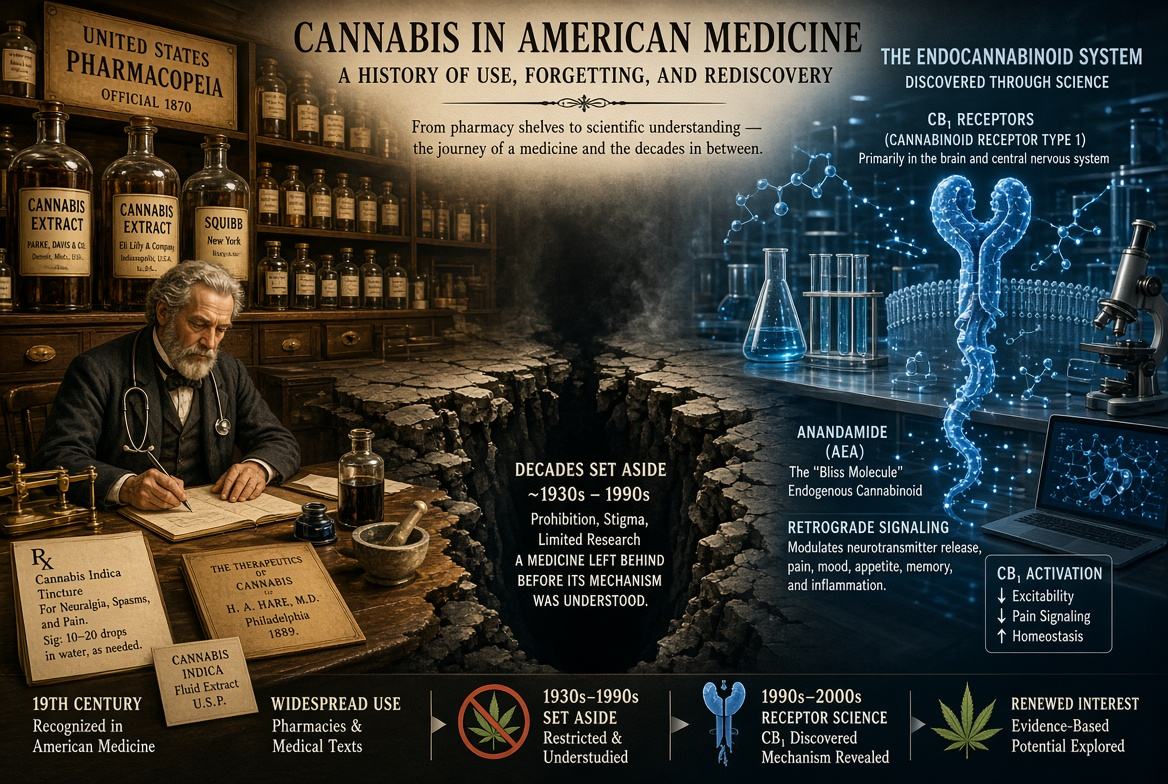
Cannabis was legitimate American medicine from 1851 to 1942. The endocannabinoid system, with CB1 receptor (1990) and anandamide (1992), gives a mechanism for effects noted by historical physicians.
By Robert Seik
In This Article
- A Medicine With a Long Record
- An Official American Medicine
- The Documented Problem Was Inconsistency
- Setting the Record Straight
- Set Aside Before the Science Caught Up
- Future Research Directions
- The Takeaway
Key Findings
- Cannabis was a legitimate article of American medicine for nearly a century. An alcoholic extract entered the United States Pharmacopeia with the revision adopted in 1850 and published in 1851, and cannabis held official status until 1942, supplied by major pharmaceutical houses [1, 2].
- Modern pharmacology has since identified the system cannabis acts on, which gives the effects historical physicians described a candidate mechanism to test: the body runs its own cannabinoid system, with the CB1 receptor identified in 1990 and the endogenous molecule anandamide in 1992 [3, 4].
- The obstacle the historical record documents is inconsistency; efficacy itself was never tested by modern methods. Preparations were adjusted against a dog incoordination assay because no chemical test existed, and modern analyses show that plant part and solvent strength each shift a tincture's cannabinoid content about tenfold while storage alters its composition over months, which is precisely the problem today's pharmaceutical science is built to solve [5, 6].
- Nineteenth-century physicians recorded detailed clinical observations, favorable and unfavorable. O'Shaughnessy described marked reductions in tetanic spasm, and Reynolds reported sustained value in migraine and sleep across decades alongside clear failures in other conditions [7, 8].
- The widely repeated claim that roughly 70 percent of American medications before 1933 contained cannabis has no identifiable source; its closest antecedent is a 1985 assertion that cannabis made up half of the medicine sold, while the one count that states its method puts cannabis near 3 to 6 percent of products [9, 10].
- Whether historical preparations were weaker than modern ones is still unresolved: century-old samples are degraded, yet a 43-year-old commercial extract retained activity, and the documented rise in seized-plant THC from about 4 percent in 1995 to about 12 percent in 2014 describes the modern illicit market and says little about the historical pharmacy [11, 12, 13].
- Medicinal use is documented across ancient China, India, Egypt, Greece, Rome, and the medieval Arabic world, with the caveat that plant identification is uncertain in several of the oldest sources [14, 15].
Few medicines have a history like cannabis. For most of a century it was an ordinary part of American pharmacy: compounded by major drug companies, written into the national drug standard, and prescribed by physicians who published what they saw. Then it left medicine, and it did so decades before scientists discovered the receptor system in the human body that it acts on. A medicine with a long record of use was set down before the science existed to pick it up and test it properly.
That sequence is why the history repays a close, unsentimental reading. The documents are real and specific: recipes, clinical case reports, manufacturing standards, procurement letters, and official monographs. They establish, beyond reasonable dispute, that cannabis was medicine. What they cannot do by themselves is prove how well it worked, and a careful reading holds both of those truths at once. The interest lies in the space between them, a space that modern pharmacology has only recently been equipped to close.
This article opens a five-part series tracing cannabis from its long career as a mainstream medicine to the modern science of the signaling system it acts on. This installment follows the documented record from the ancient world through its American pharmaceutical career, separates what is solid from what is merely repeated, and shows why the questions the history raises are now, at last, answerable.
A Medicine With a Long Record
The medicinal use of cannabis is old, real, and strikingly widespread. Chinese materia medica carry the longest continuous record. Scholarship by Brand and Zhao separates the legendary attribution of the foundational herbal to a prehistoric sage from its actual compilation around the first or second century CE, traces how different drug names mapped to different parts of the plant, and describes a remedy attributed to the seventh-century physician Sun Simiao that used cannabis for the severe pain of broken bones; the same review notes that the formula for Hua Tuo's famous surgical preparation has not survived, so its cannabis content remains conjecture [14]. Archaeology adds a firmly dated anchor: chemical residue from wooden braziers at the Jirzankal cemetery in the eastern Pamirs, around 500 BCE, shows that cannabis rich in psychoactive compounds was burned during mortuary rites, which establishes both the early selection of potent plants and early inhalation, while placing the use in a ritual rather than a strictly medical setting [15].
The Mediterranean, Egyptian, and South Asian records add specific preparations. An Egyptian eye remedy in a Middle Kingdom papyrus is among the oldest cited, though the identification of its plant term is still debated [16]. Pliny the Elder describes cannabis remedies for the ears, root decoctions for cramped joints and gout, and raw root applied to burns, while classical scholarship cautions that some ancient accounts of "wild cannabis" may describe hemp mallow instead, and that a Dioscoridean earache preparation leaves the exact plant part open [17, 18]. The medieval Indian Anandakanda records milk-based mixtures and preparations with ghee, honey, or sugar, alongside powders and pills, and Arabic medicine supplies some of the most specific pre-modern prescriptions, including Ibn Masawayh's ninth-century seed-oil ear preparations and juice of the leaves applied to the skin [19, 20]. One qualifier belongs in any serious account: the oldest texts do not always let us be certain the plant named is the one we mean today. The breadth of medicinal interest is not in doubt; some of the botanical detail is.
The modern Western chapter opens with real clinical ambition. William Brooke O'Shaughnessy, a physician and chemist working in India in the early 1840s, introduced cannabis preparations to European and American medicine. His 1843 report, published in two parts, described the preparations he encountered and helped make, including the confection majoon, and then presented clinical cases: patients with tetanus whose spasms eased under hemp resin, several who recovered, and one who later died amid gangrene and dysentery after receiving, among other treatments, a hemp poultice [7]. The structure of that report is itself instructive. He recorded what he saw in uncontrolled cases that received concurrent care, so a reduction in spasm is a real observation, while a final outcome cannot be pinned on any single treatment. Read on its own terms, his work did what good early clinical reporting does: it carried a method and a hypothesis, and physicians across two continents took both up. By the end of the century, John Russell Reynolds, physician to Queen Victoria's household, could summarize thirty years of his own use, reporting sustained value in migraine and in the sleeplessness of older patients, and in several spasmodic complaints [8]. Reynolds also recorded where cannabis failed him, in conditions such as sciatica and chronic epilepsy, and where unpredictable preparations caused trouble, and that candor gives his favorable observations more weight than a promoter's would carry. A careful clinician reported benefit, repeatedly, across decades, in observations no one could yet test under controlled conditions.
An Official American Medicine
Clinical practice became official standard. The United States Pharmacopeia revision adopted at the 1850 national convention and published in 1851 listed Extractum Cannabis, an alcoholic extract of the flowering tops of Cannabis sativa, and cannabis preparations remained official through successive revisions until 1942 [1, 2]. Over those decades the official listings grew to cover the crude drug, the extract, and the fluidextract, the standard dosage forms of the day. Major pharmaceutical houses manufactured and sold cannabis as a routine product: the American Institute of the History of Pharmacy preserves a Parke-Davis fluidextract bottle made in 1928 [21], and a 1918 letter from Eli Lilly seeking high-grade American-grown cannabis for its production needs [22]. These surviving objects show that the largest firms in American medicine treated cannabis as an ordinary, catalogued article of commerce, though they quantify neither total sales nor prescriptions. For ninety years, cannabis sat in the same cabinets, catalogs, and price lists as the rest of accepted medicine.
The Documented Problem Was Inconsistency
The obstacle the record documents most clearly is that physicians could not make cannabis consistent. Whether it worked as well as its advocates believed was never tested by the methods modern medicine would accept, so the record establishes inconsistency as the obstacle without settling efficacy. The official American tincture formula shows the problem exactly: the 1918 United States Dispensatory directs about 100 grams of cannabis to roughly 1,000 milliliters of tincture, with the finished product adjusted by producing incoordination in dogs, because no chemical assay for the active compounds yet existed [5]. A potency test run on animals measures how little the chemistry of the day could offer. Modern laboratory work shows how much that mattered: in a controlled study of traditional-style tinctures, flowering-top extracts carried about ten times the cannabinoids of leaf extracts, strong ethanol pulled far more than weak, and storage steadily converted the acidic cannabinoids over months [6]. The same plant, prepared two reasonable ways, could yield very different medicines. For a physician at the bedside, that variability carried real consequences: a dose that soothed one patient could overshoot in the next and produce the alarming intoxication Reynolds and others recorded, while a weak or decomposed batch could do nothing at all. William Woodward of the American Medical Association later tied part of the decline in medical use to this variability and uncertain dosing [25], and the newer synthetic medicines that could be dosed exactly were, by the early twentieth century, an easier choice for physician and manufacturer alike.
This was a solvable problem, and the tools to solve it now exist. Analytical chemistry can characterize a batch to the milligram, a certificate of analysis can travel with a product, and a standardized extract can hold a fixed ratio of cannabinoids from lot to lot, which is precisely what nineteenth-century pharmacy could not do. The documented limitation was measurement, and measurement is what the intervening century has perfected.
The related question of whether the old preparations were weak or strong is, in fairness, still open, and the evidence points both ways. Four separate things tend to be conflated in that debate: how much cannabinoid the living plant held, how concentrated the finished preparation was, how much a patient actually received, and what the passing century has done to any sample that survives. Century-old cannabis kept in a museum is dominated by cannabinol, the breakdown product of THC, so it tests weak today without telling us what it was when fresh [11]. Pointing the other way, a pharmaceutical cannabis fluidextract still showed biological activity when it was tested at 43 years old, which suggests that at least some commercial preparations were active and durable [12]. Water-based preparations widen the range further: a 2024 analysis of pharmacy-grade cannabis tea found that a single serving could deliver anywhere from under half a milligram to more than eleven milligrams of THC depending on the product [23, 24]. The one firmly documented potency trend is modern, with THC in seized U.S. cannabis rising from about 4 percent in 1995 to about 12 percent in 2014 as growers bred for strength [13]. That trend describes the modern illicit market and says little about an 1890 prescription. The fair summary is that historical strength is unresolved, and that what the record actually documents is inconsistency, exactly the thing modern standardization is designed to fix.
Setting the Record Straight
A history this solid does not need embellishment, which is why one popular claim deserves correcting. You will often read that about 70 percent of American medicines before the 1930s contained cannabis. No original source for that figure exists. The closest traceable root is Jack Herer's 1985 book, which claimed cannabis made up half of the medicine sold between 1842 and 1900, a figure his own research collaborator later acknowledged was stretched [9]. The only count that states its method, a collector's tally across old pharmaceutical catalogs, puts cannabis nearer 3 to 6 percent of products [10]. Cannabis was a real and respected medicine, and also a minority one in a pharmacy dominated by other botanicals and, increasingly, early synthetics. The documented truth carries the story on its own, and leaning on the inflated number only hands skeptics an easy target.
Set Aside Before the Science Caught Up
Cannabis did not leave medicine in a single dramatic ban, and the most telling account comes from the physician who fought the 1937 federal law. Testifying against the Marihuana Tax Act, Dr. William Woodward of the American Medical Association said medical use had already declined, tied part of that decline to the drug's variability and uncertain dosing, denied any link between medicinal use and addiction, and warned that a prohibitive law "loses sight of the fact that future investigation may show that there are substantial medical uses for Cannabis" [25]. Five years later, in 1942, cannabis was dropped from the Pharmacopeia, closing ninety years of official status [2].
Within half a century, the investigation Woodward called for gained a new starting point. In 1990, researchers cloned the first cannabinoid receptor, now called CB1 [3]. In 1992, they isolated anandamide, the first of the body's own molecules that act on it [4]. The human body, it turned out, runs an entire signaling system that cannabis engages, a network of receptors and the body's own cannabinoid molecules involved in regulating pain, appetite, mood, and inflammation, and medicine learned this only after setting the plant aside. This is the heart of the series' question, and it is a hopeful one: the biological rationale that nineteenth-century physicians lacked now exists. It is a reason to investigate seriously, not yet proof of benefit.
What the discovery changed is the plausibility of the old reports. The endocannabinoid system works through on-demand, local signaling that quiets the release of other neurotransmitters, a mechanism consistent with the effects on pain, muscle spasm, and sleep that the nineteenth-century literature kept describing [26]. That consistency gives their observations a candidate mechanism without proving those physicians right about any given patient, which is the difference between an anecdote and a testable hypothesis, and it is why the questions the history raises can now be taken into the laboratory instead of left in the archive.
Readers can find that system explained in Hytiva's Endocannabinoid System Guide. How and why the door closed, and what the closing cost, is the subject of the next installment.
Future Research Directions
The history leaves a set of concrete, answerable questions, and the point now is to finish what the nineteenth century started.
An archival census with explicit denominators. The 70 percent episode persists because no rigorous count exists. A historian-pharmacist team could build one from defined sources, including manufacturer catalogs across sampled years, surviving prescription ledgers, and wholesale druggist price lists, each reported with its own denominator. Such a census would replace folk statistics with a citable figure and finally settle cannabis's true place in the historical pharmacy. It would describe how widely cannabis was used and would say nothing about effectiveness.
Chemical reconstruction of documented preparations. The 1918 Dispensatory tincture and the 1851 extract are reproducible recipes. Preparing them from analytically characterized modern plant material, with certificates of analysis for the starting botanical, and quantifying the delivered cannabinoids per historical dose unit would convert formulation ratios into estimated milligram exposures for the first time. Aging the reconstructed preparations under period-plausible storage, extending published stability work on traditional tinctures and teas [6, 23], would bound how much potency a dispensed bottle plausibly kept.
Specimen analytics with degradation modeling. Museum and archival collections hold more pharmacy-era cannabis than has been analyzed. A systematic mass-spectrometric survey of provenanced specimens, paired with cannabinoid degradation kinetics to back-calculate plausible original THC ranges from cannabinol-to-THC ratios, could narrow the central open question of historical potency. The approach yields ranges with stated uncertainty and depends on provenance research to anchor harvest dates.
A route-matched test of a historical indication. Reynolds's strongest claimed indication, migraine, is now investigable with tools he lacked. A double-blind crossover study in episodic migraine comparing a characterized full-spectrum oral extract against a THC-plus-CBD isolate combination matched milligram-for-milligram, both from commercially available, certificate-of-analysis-verified products, with plasma pharmacokinetic sampling, would test a nineteenth-century observation and the modern formulation question at the same time. A trial of this design can establish short-term efficacy against placebo and between formulations for a defined product; it cannot validate historical practice wholesale.
The Takeaway
The record establishes something substantial. Cannabis was an established medicine: prescribed across cultures, adopted by careful nineteenth-century physicians who reported benefit, manufactured by major American firms, and official in the United States from 1851 to 1942. Modern pharmacology has since identified the biological system that makes those historical observations plausible. Taken together, this is a strong case that cannabis deserves serious therapeutic investigation.
What the history does not do is prove, on its own, that cannabis works for any particular condition. The physicians of that era could not measure a dose or run a controlled trial, and they recorded failures alongside favorable observations [7, 8]. The most inflated modern claims, the 70 percent figure among them, do not survive scrutiny [9, 10]. For readers who encounter historical framing in today's marketplace, two present-day facts matter: dispensary products are chemically and legally different from the old pharmacy preparations, and no dispensary cannabis product is FDA-approved to treat any medical condition [27].
The possibility is real, and so is the work still required to test it. A medicine with a long record of use and a now-identified candidate mechanism was set aside before it could be tested properly, and the tools to finish that testing finally exist. The archival census, the chemical reconstructions, and the route-matched trial outlined above are how the field can turn a long clinical history into an answer. The next installment examines how the door closed, and what the closing cost scientific inquiry itself.