Cannabis and Parkinson's Disease
Last Updated
Viral clip of cannabis easing Parkinson’s drives interest beyond trials. 2026 evidence is layered: plausible via endocannabinoids, mixed controlled data. Review separates science from narratives.
The dramatic patient videos are real, but the science tells a more careful story.
Key Takeaways
- Many people first hear about cannabis for Parkinson's through powerful patient videos. Those stories are worth taking seriously, and they are also why careful research matters so much.
- The most consistent benefits in studies so far are in non-motor symptoms, things like sleep, anxiety, and overall quality of life, where some people feel meaningfully better.
- CBD and THC are very different compounds. CBD tends to be gentler and is where most of the encouraging non-motor research sits, while THC is more likely to cause side effects that matter for people with Parkinson's.
- Cannabis is not a proven treatment for the tremor, stiffness, and slowness of Parkinson's, and it is not a replacement for the medications your doctor prescribes.
- If you are curious, the safest path is a conversation with your neurologist, ideally starting low and going slow.
Why So Many People Are Asking About This
If you have spent any time online looking into Parkinson's disease, you have probably come across a video that stops you in your tracks. In the documentary Ride with Larry, a man living with advanced Parkinson's takes a cannabis preparation and, within minutes, his tremor and stiffness appear to ease and his speech becomes clearer. It is genuinely moving to watch, and it has done more to spark public interest in cannabis for Parkinson's than any study ever has.
That kind of story deserves both respect and honesty. It is real to the person living it, and it is also a single moment captured on camera, without the comparisons and safeguards that scientists use to know whether a result is reliable or coincidental. Parkinson's symptoms naturally come and go over the course of a day, and the timing of regular medication plays a role too, so a dramatic on-camera moment does not necessarily tell us what cannabis would do for the next person. The useful question, and the one this article focuses on, is what researchers have actually found when they study cannabis carefully. The answer is hopeful in some places, uncertain in others, and worth understanding clearly.
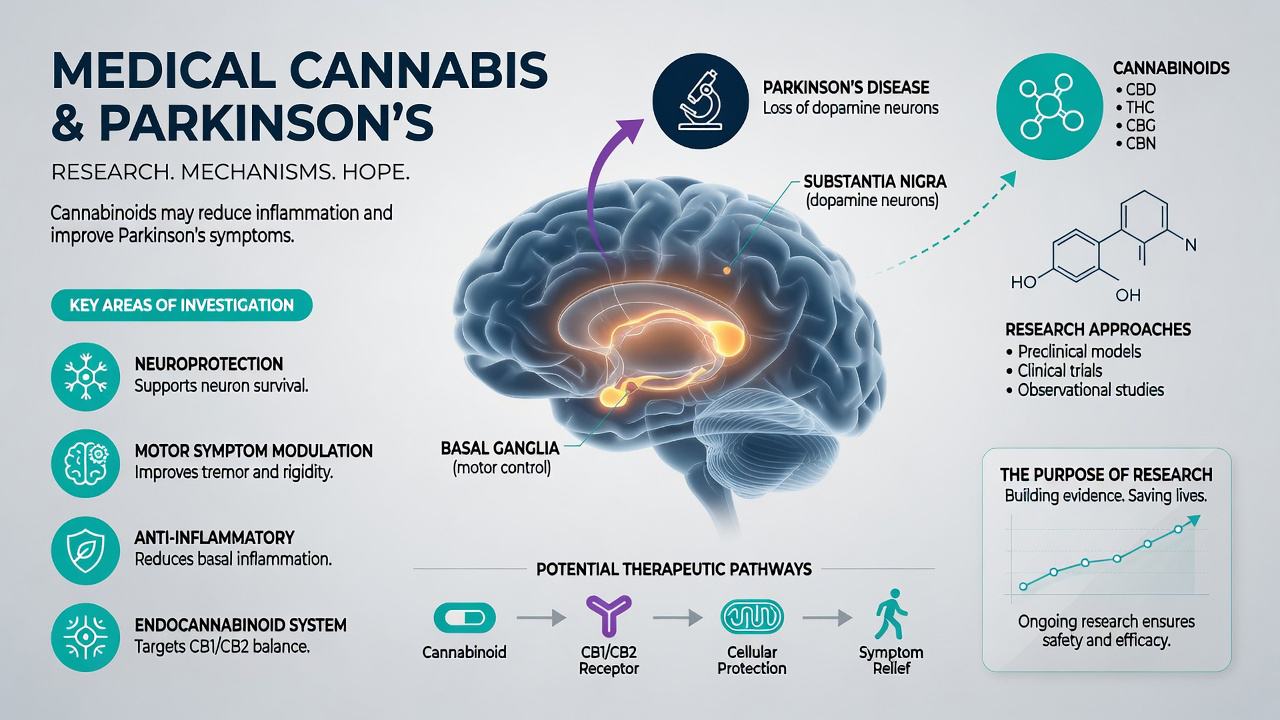
A quick foundation first. Parkinson's disease is a condition in which certain brain cells that produce dopamine, a chemical that helps control movement, are gradually lost. Most people know it for its movement symptoms: tremor, stiffness, and slowness. But Parkinson's also brings non-motor symptoms such as trouble sleeping, anxiety, pain, and mood changes, and many people say those are just as hard to live with. This distinction between motor and non-motor symptoms turns out to be the key to understanding where cannabis may and may not help.
Where the Evidence Looks Most Encouraging
Here is the good news, and it is real. The area where studies most consistently point to a benefit is in how people feel day to day rather than in their movement scores.
In one careful clinical trial, people with Parkinson's who took a moderate daily dose of CBD reported a meaningful improvement in their quality of life compared with those who took a placebo.[^2] They did not show measurable changes on the standard movement test, but they felt better overall, which is not a small thing when you are living with a chronic illness. A wider review of the CBD research points in the same direction, finding that CBD was generally well tolerated and was linked to improvements in non-motor areas such as mood, certain sleep problems, and day-to-day functioning.[^4]
Sleep is a particularly promising thread. In a recent real-world report, a small group of people with Parkinson's used a low-dose cannabis extract containing both THC and CBD for three months. Those on the lower dose said their insomnia improved, though the same study found no change in daytime sleepiness or thinking and memory.[^1] The researchers were careful, and so are we: this was a very small group with no placebo comparison, so it points to a possibility worth studying rather than a settled fact. Still, sleep trouble is common and under-treated in Parkinson's, and the signal here is encouraging enough to take seriously.
The overall pattern across the research is steady rather than flashy. For some people, cannabis, and CBD in particular, appears to help with sleep, anxiety, and general well-being, and it tends to be reasonably well tolerated. That is a genuinely useful thing to know, and it is a more grounded promise than the viral videos suggest.
What the Research Does Not Yet Show
This is the part that takes a little honesty, and you deserve it. The dramatic videos are almost always about movement, the visible tremor and stiffness easing. But movement is exactly where careful studies have been least able to confirm a benefit.
The clinical trial mentioned above found no measurable improvement in movement scores, even though people felt better in other ways.[^2] Looking across the broader research, a review of the available meta-analyses found that benefits for movement symptoms show up much more strongly in laboratory and animal studies than in actual human trials, and that we still lack the large, rigorous studies needed to say anything firm.[^6]
So why do so many people feel that cannabis helps their tremor? Several things can be true at once. Feeling calmer, less anxious, or better rested can genuinely make symptoms feel more manageable, and that relief is real even if it does not show up on a movement test. Think of how a good night's sleep can make a stressful day feel lighter without changing anything about the day itself. Parkinson's symptoms also fluctuate naturally, so a good moment after taking cannabis may not be caused by the cannabis. And a striking effect seen minutes after a dose is not the same as a lasting improvement measured over weeks. None of this means cannabis does nothing. It means that, for now, the honest summary is that cannabis has not been shown to be a reliable treatment for the movement symptoms of Parkinson's, and it should never replace the medications your doctor has prescribed.
CBD and THC Are Not the Same Thing
One of the most useful things to understand is that "cannabis" is not a single ingredient. The two best-known compounds, CBD and THC, behave very differently, and the difference matters a lot if you have Parkinson's.
CBD is the compound behind most of the encouraging non-motor research. It does not cause a high, tends to be gentler, and works through a range of pathways in the body.[4] THC is the compound responsible for the high, and while it has its own potential uses, it is also more likely to cause side effects that are especially risky for people with Parkinson's, including dizziness on standing, confusion or memory trouble, increased fall risk, and in some cases worsened confusion or hallucinations. Because many people with Parkinson's are older and may already be vulnerable to these issues, the CBD-versus-THC distinction is not just a technicality. It is a real safety consideration, and it is one of the main reasons that starting low and working with a clinician matters.
This is also why a good experience someone reports with one product tells you very little about a different one. A high-CBD oil and a high-THC product are, in practical terms, two different things.
The Promising Research Still in the Lab
You may have read that cannabis might protect brain cells or even slow Parkinson's down. This is one of the most exciting ideas in the field, and it is important to be clear about where it stands: it is promising laboratory science, not something shown to work in people.
In studies using cells and animal models, CBD has shown an ability to shield neurons from certain kinds of stress and damage, partly by supporting the cell's natural antioxidant defenses.[^5] Reviews of this laboratory research find the results encouraging and consistent enough to justify testing in humans.[^3] That is a meaningful step, and it is why scientists remain interested.
But the leap from a protected cell in a dish to a slowed disease in a person is enormous, and the history of Parkinson's research is full of treatments that looked wonderful in the lab and did not pan out in patients. So this is a reason for optimism about future research, not a reason to expect that cannabis available today will protect your brain or change the course of your disease. Honesty here protects you from disappointment and from spending money on promises the science has not yet earned.
A Few Honest Limitations
It helps to know why the science is not further along, because the gaps are mostly about how hard this research has been to do, not about cannabis failing. The human studies so far have mostly been small and short, often a few dozen people for six weeks or less, which makes it hard to detect modest benefits or to know about long-term safety.[^2][^4] The products studied have also varied widely, from pure CBD to mixed extracts, so results do not always transfer from one to another.[^1][^6] And laws and regulations have made it genuinely difficult for researchers to run the large, careful trials that would give clearer answers. The encouraging part is that interest is growing, better-designed studies are underway, and the real signals around sleep and well-being give researchers a clear place to focus next.
For a full clinical review of the evidence, see our companion Hytiva Research article, Cannabis Therapeutics in Parkinson's Disease.
If you would like to understand the idea of using very low amounts of cannabis, which is the approach behind much of the encouraging sleep and well-being research, you may find our Hytiva /learn guide Microdosing Cannabis a helpful next read.
Where to learn more: The Parkinson's Foundation offers patient-friendly, expert-reviewed guidance on cannabis and Parkinson's, including its own cautious consensus position, at parkinson.org/living-with-parkinsons/treatment/medical-marijuana.
Frequently Asked Questions
Can cannabis cure Parkinson's disease? No. There is no evidence that cannabis cures Parkinson's or slows it down in people. The neuroprotection research that gets people excited is still at the laboratory stage.
Will it help my tremor? You may feel better overall, but careful studies have not shown that cannabis reliably improves the movement symptoms of Parkinson's, including tremor. Some people feel their symptoms are more manageable, which may come from better sleep or reduced anxiety rather than a direct effect on movement.
What is it most likely to help with? The most consistent research signals are in non-motor symptoms, especially sleep, anxiety, and overall quality of life. Many people also find it reasonably well tolerated.
Is CBD or THC better for Parkinson's? Most of the encouraging non-motor research involves CBD, which is gentler and non-intoxicating. THC is more likely to cause side effects that are risky for people with Parkinson's, such as dizziness, confusion, and falls. This is a key reason to involve your doctor.
Can I use cannabis instead of my Parkinson's medication? No. Cannabis is not a replacement for your prescribed treatment. Stopping or changing your medication can be harmful. Any use of cannabis should be discussed with your neurologist and added to, not substituted for, your existing care.
If I want to try it, what is the safest way? Talk with your neurologist first, especially about interactions with your current medications. If you and your clinician decide to proceed, the general principle is to start with a low dose and increase slowly, paying close attention to side effects like dizziness, confusion, or balance changes.