Congress Delays Federal Hemp THC Ban to December 11 as Industry Presses for Rules
Last Updated
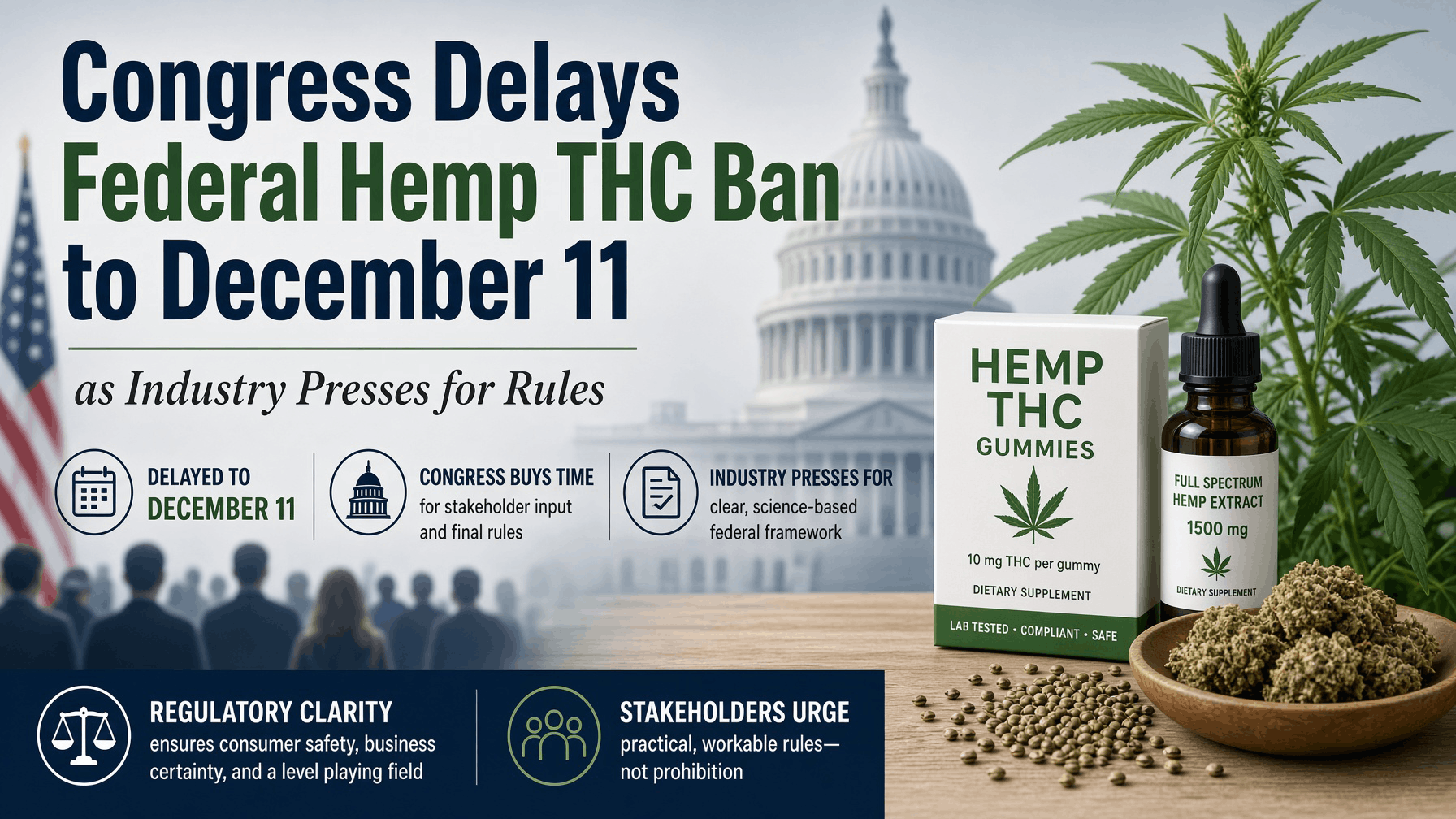
Congress delayed most of a federal hemp THC ban, including a 0.4-milligram cap, to December 11, 2026.
A ban already on the books, with a new clock
The federal hemp THC ban is already law. It is not a proposal still moving through Congress. As of early October 2026, most of it is set to take effect on December 11, not November 12. Congress passed the restriction in November 2025. President Donald Trump signed it as part of the bill that ended the longest government shutdown in U.S. history. The rule caps finished hemp products at 0.4 milligrams of total THC per container. That limit sits far below the dose in most intoxicating hemp products now on the market, including many gummies and hemp-derived THC drinks. In September, lawmakers moved the main date. A short-term funding bill delayed the start for most products from November 12 to December 11. The House passed that bill 370 to 48 on September 1, and Trump signed it the next day. Products made with cannabinoids the plant cannot naturally produce still lose federal hemp status on November 12. Everything else, including the total-THC test and the per-container cap, waits until December 11. The delay is short. The industry is using the extra weeks to press Congress for rules instead of a ban. One market estimate says the restriction could cut retail revenue by $28.3 billion and displace about 225,000 jobs.
What the federal hemp THC ban does
The ban changes the test for legal hemp. Under the 2018 Farm Bill, hemp could contain up to 0.3 percent delta-9 THC by dry weight. The new rule uses total THC instead. That count includes delta-9, THCA, and other THC forms, not delta-9 alone. Finished products face a second limit. A container of a hemp-derived cannabinoid product may hold no more than 0.4 milligrams of total THC. News reports describe that cap as low enough to cover most intoxicating hemp products now sold, including gummies, drinks, and smokable flower. The same threshold also reaches some non-intoxicating goods. Full-spectrum CBD often carries trace THC. The Washington Times noted that oils, lotions, edibles, and beverages in that category could fall outside the legal hemp definition if a container exceeds the cap. Products over the line would no longer count as hemp. They would be treated as marijuana, which remains a controlled substance that cannot legally move across state lines. The Hill reported that the change was written to close the Farm Bill hemp loophole that let these goods spread outside state marijuana systems. Industrial hemp grown for fiber, grain, and other non-cannabinoid uses is not the target. The cap is aimed at cannabinoid products for human or animal use, and it puts most current hemp THC items on the wrong side of the 2026 line.
How the Farm Bill hemp loophole produced the market
The current fight starts with the 2018 Farm Bill. That law removed hemp from the federal controlled-substances list and set a simple test. A cannabis plant counted as hemp if it held no more than 0.3 percent delta-9 THC by dry weight. Sen. Mitch McConnell of Kentucky championed that language to give farmers a legal crop. The Associated Press reported that the delta-9-only test did more than that. Processors could start with legal hemp and end with intoxicating products. Delta-8 THC, other converted cannabinoids, and hemp-derived THC drinks all grew out of that gap. Those goods did not move through state marijuana systems. They showed up in gas stations, smoke shops, convenience stores, and, in some cases, mainstream retailers. THC seltzers even reached some Target stores, according to the same reporting. Dozens of states later regulated or banned impairing hemp products on their own. Others left a wider market in place, and federal law lagged behind. McConnell later moved to close the opening he had helped create. Late in 2025, he inserted the tighter language into the spending bill that ended the shutdown. That provision is the ban now on the calendar. The one-year wait before it takes effect is what pushed the main deadline into 2026.
The September delay and the two effective dates
The date shift came through a must-pass funding bill. In August, the Senate unveiled a continuing resolution that would fund the government into December and pause most of the ban. Forbes reported that industry allies treated the delay as a chance to seek rules instead of a prohibition. The Senate later passed the bill 90 to 6. The House followed on September 1. It approved the same measure 370 to 48, The Hill reported. Nineteen Republicans and 29 Democrats voted no. Some hard-line Republicans opposed the bill in part because of the hemp language. President Trump signed it on September 2. The Hill also reported that the delay was added at the White House’s request, and that the administration has treated a delay, or a rewrite, as a priority. The new law does not move every deadline. Most of the ban, including the total-THC test and the 0.4 milligram cap, now lands on December 11. Products that contain cannabinoids the plant cannot naturally produce still lose hemp status on November 12. Roll Call described that split as a pause on many naturally derived goods, with the synthetic exclusion left on the original date. The delay itself was contested. Sen. Ted Budd tried to strip it from the funding bill. The Washington Times reported that the amendment failed, but 31 other senators backed it. That vote showed the ban still divides Congress, even after the one-month reprieve.
Industry response and the political split
The hemp industry is treating December 11 as a deadline, not a repeal. The Associated Press reported a Whitney Economics estimate that the ban could cut retail revenue by $28.3 billion, displace about 225,000 jobs, and reduce state sales-tax potential by $2.1 billion. Producers say those figures are why they want regulation before the cap takes effect. Their offer is narrower than the status quo. Advocates have told lawmakers they would accept sales limited to adults 21 and older, a lower package limit on THC, and a ban on imported cannabis compounds. Owners of Kentucky’s Cornbread Hemp said they are prepared to cap products at about 5 milligrams if that is what wins support. The U.S. Hemp Roundtable has framed the same goal as a federal system that blocks youth access and keeps lawful hemp products on the market. Opponents describe the same goods as a public-safety problem. McConnell backed the original restriction as a way to keep intoxicating hemp products away from minors. Budd and other lawmakers have argued that these products sit in ordinary retail and put children at risk. They want the ban to take effect, not to be rewritten into a regulated market. The split is not only industry versus Congress. Roll Call reported that some House Republicans, including Rep. Andy Harris, want the delay undone. At the same time, the administration has pointed to a separate bill that would raise the legal limit, restrict sales to adults, and add a federal tax on beverages and edibles. Neither side has a finished deal.
What remains unresolved before December 11
The one-month delay did not settle the policy. As of the first week of October 2026, Congress had not passed a permanent framework for intoxicating hemp products. The 0.4 milligram cap is still the law. It is only waiting on a later start date. The White House has asked lawmakers to revise that language rather than leave the ban as written. Reporting has tied that request to full-spectrum CBD, which can carry trace THC and could be swept up with hemp-derived drinks and gummies. A narrower carve-out is one option. A broader set of rules, including age limits and package caps, is another. A further delay is also in the mix, and it remains contested. If Congress does nothing, most of the restriction arrives on December 11. Products made with cannabinoids the plant cannot naturally produce face the earlier November 12 date. Until lawmakers act, the Farm Bill loophole is on a short clock, and the 2026 ban is still set to close it.