CBN Facing Total Ban in Japan as Government Tightens Rules
Last Updated
Japan cracks down and bans CBN, now on the list of designated drugs. The ban takes effect June 1.
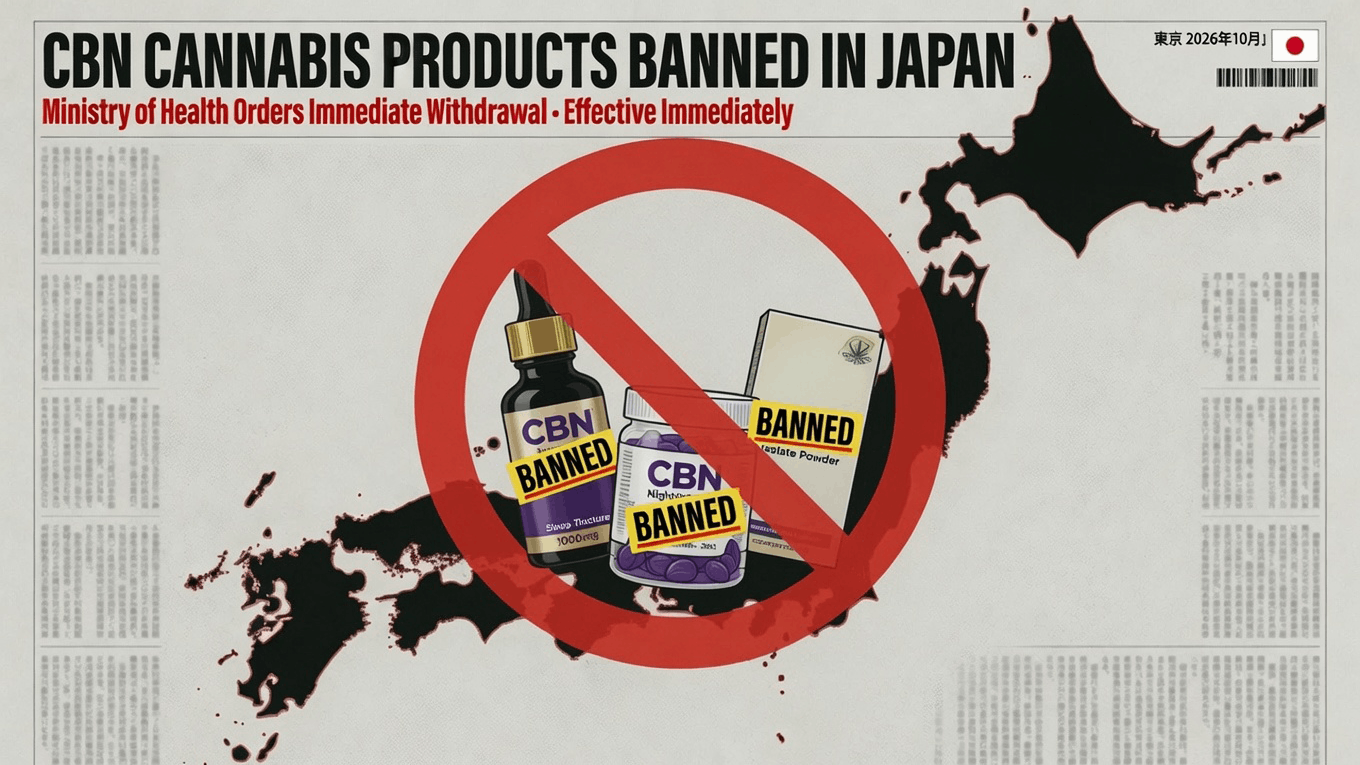
TOKYO — Japanese health officials have imposed a full prohibition on cannabinol, commonly known as CBN, a compound obtained from cannabis plants. The move ends the legal production, distribution, ownership and personal use of the substance across the country. The restrictions came into force on June 1 after authorities added CBN to the list of designated controlled substances.
The Ministry of Health, Labour and Welfare updated relevant regulations to bring CBN under stricter oversight. Under the revised rules, companies can no longer make or import items containing the compound, and retailers must stop selling them. Individuals who possess CBN products now risk criminal charges that can include prison sentences of up to five years along with financial penalties. A narrow pathway remains for approved medical applications in specific cases.
Until recently, CBN existed outside the main framework that governs other cannabis-related ingredients. Companies sold it openly in items such as gummies, baked goods, oils and vaping liquids. Many of these products carried claims about supporting restful sleep or easing tension. Because the compound had not faced the same level of scrutiny as tetrahydrocannabinol, or THC, it occupied an unregulated space that allowed wider availability in stores and through online channels.
Concerns rose when producers began offering versions with significantly higher concentrations. Reports of negative reactions among users prompted a closer look by regulators. In one documented situation last spring, a student enrolled at Yamanashi Gakuin University in central Japan suffered injuries after jumping from a dormitory window. Investigators determined that the student had consumed edibles containing elevated amounts of CBN shortly before the event.
After receiving multiple accounts of people becoming unwell, ministry staff examined the safety profile through controlled laboratory testing on animals. The results showed that larger doses could produce hallucinatory effects and other troubling responses. These findings contributed to the decision to classify the compound more tightly and remove it from general consumer access.
All remaining stock of CBN products must now be taken off physical shelves and deleted from e-commerce sites. Shop owners have been instructed to clear their inventories completely. People who still have any items containing CBN in their homes or possession are advised to discard them responsibly to stay compliant with the new requirements.
The action reflects Japan’s ongoing effort to address newer cannabinoid compounds as they gain traction in the wellness sector. Similar steps have been taken with other substances when safety questions surfaced. Regulators stated that the goal is to reduce the chance of further health incidents tied to products that had not undergone standard safety evaluation.
CBN forms when tetrahydrocannabinol breaks down through natural oxidation. It appears in trace amounts in older cannabis material. In recent years it became popular in formulated consumer goods positioned as gentler options compared with stronger cannabinoids. Market activity around these items had expanded noticeably before the regulatory shift.
Travelers and residents alike should note that bringing CBN products into Japan is no longer permitted. Customs authorities are enforcing the updated controls at entry points. Anyone unsure about items they own should check current guidance from the health ministry on proper disposal methods.
The prohibition does not extend to every cannabis-related ingredient. Other compounds, such as certain forms of CBD that meet strict zero-THC standards, continue to follow separate rules. The ministry indicated it will keep evaluating new substances that enter the market and may adjust policies based on emerging evidence.
This latest classification brings CBN into line with Japan’s established approach to substances that show potential for misuse or adverse effects at higher strengths. Officials emphasized that protecting public well-being remains the central priority behind the change. Consumers and businesses are expected to adjust quickly to avoid violations as enforcement begins in full.