CBD and Seizures
Last Updated
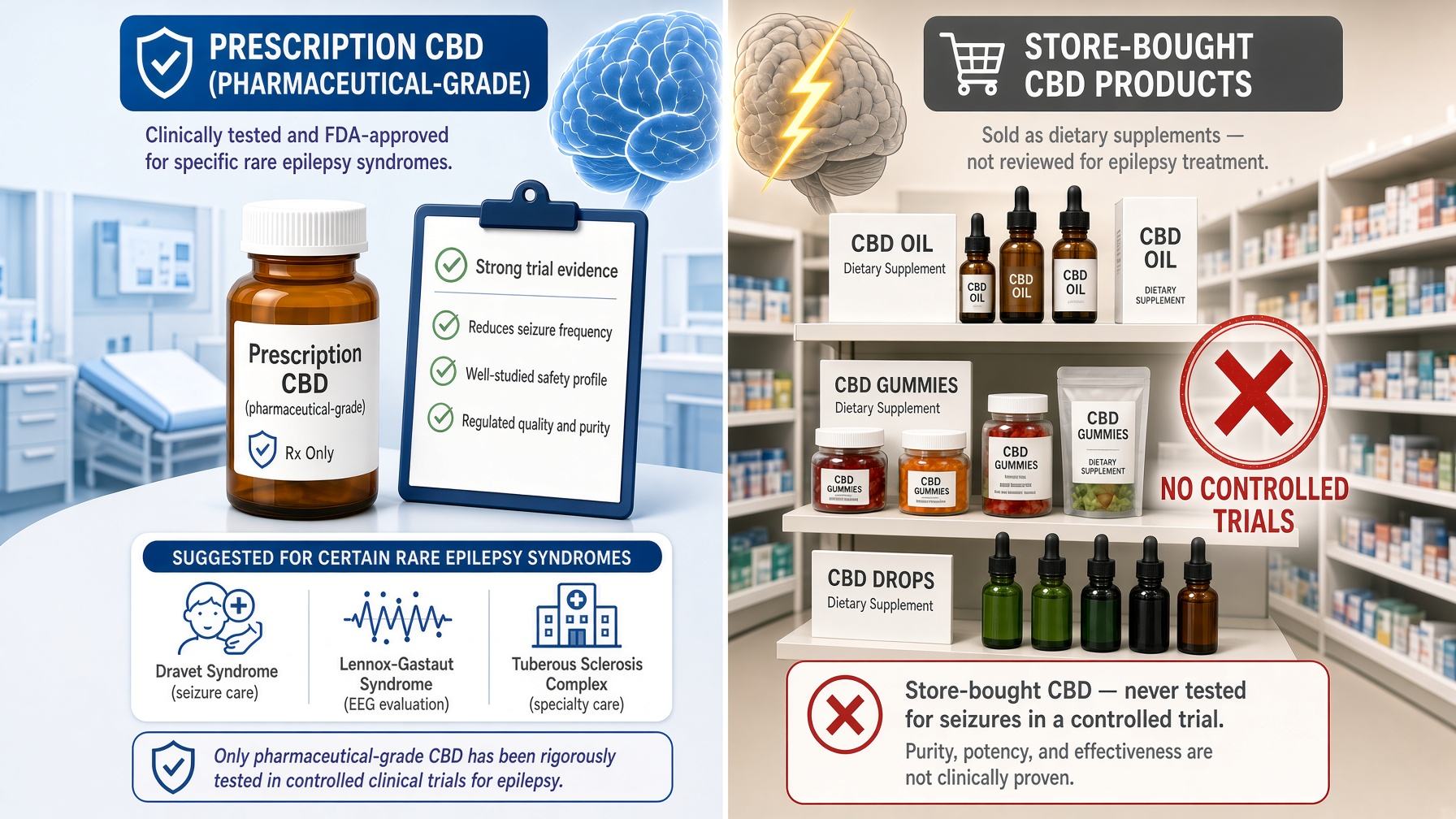
A prescription form of CBD has strong trial evidence in three rare epilepsy syndromes. The CBD sold in stores has never been tested for seizures in a controlled trial.
Key Takeaways
- A prescription CBD medicine reduced seizures in five randomized trials and is FDA-approved for three rare epilepsy syndromes in patients one year and older.
- No dispensary, hemp-derived, or over-the-counter CBD product has ever been tested for seizures in a randomized trial. The evidence for those products comes from parent surveys and medical chart reviews.
- When researchers measured CBD in children's blood, store-bought products delivered less than half the amount the prescription version did.
- Of 80 retail CBD products analyzed in a laboratory, most contained THC, including several labeled THC-free.
- CBD is an active drug. It changes the blood levels of some seizure medicines, can affect the liver, and requires blood monitoring when prescribed.
About a third of people with epilepsy keep having seizures even after trying two or more medications. For families in that position, especially families of children with severe, early-onset epilepsy, the search for something else is constant and it is reasonable. CBD has been the most prominent candidate for more than a decade.
The evidence on CBD and seizures is stronger than the evidence on cannabis for almost anything else. It is also narrower than most people assume, and it attaches to one specific product that requires a prescription. The gap between that product and the bottle on a dispensary or pharmacy shelf is the single most important thing to understand here, because the two are not interchangeable and the research does not transfer from one to the other.
What the Prescription Version Proved
A purified, pharmaceutical-grade CBD solution was tested against placebo in five randomized trials. Children and adults in those trials kept taking their existing seizure medications, and CBD was added on top.
In Dravet syndrome, monthly convulsive seizures fell by about 39 percent on CBD against about 13 percent on placebo [1]. In tuberous sclerosis complex, seizures fell by roughly 49 percent against 27 percent on placebo [2]. Two further trials in Lennox-Gastaut syndrome found similar separations for drop seizures. Every trial hit its main target, and the results held up across separate research teams and countries.
Those results are why the FDA approved the medicine, sold as Epidiolex, for seizures associated with Lennox-Gastaut syndrome, Dravet syndrome, and tuberous sclerosis complex, in patients one year of age and older [3]. It is a prescription drug with a known concentration, a defined dose in milligrams per kilogram of body weight, and required lab monitoring.
That is a strong record. Very few plant-derived treatments for anything have five positive randomized trials behind them.
What Those Trials Did Not Show
Three limits matter for anyone reading those numbers.
The medicine was added to existing treatment, never tested on its own, and never compared against another seizure drug. What the trials show is that adding it helps more than adding a placebo.
The benefit was a reduction in seizures, not an end to them. In the main Dravet trial, 5 percent of children on CBD became seizure-free, against none on placebo, and that difference was small enough that it could have been chance [1]. Most responders got fewer seizures, not zero.
The evidence also stops at the edges of those three syndromes. The most common form of drug-resistant epilepsy in adults is focal epilepsy, and the one randomized trial in that group found no benefit at either dose tested [4]. Off-label use outside the three approved conditions is common and may turn out to be justified for some patients. As of now, the trial evidence for it is not there.
The Stories You Have Heard
Public interest in CBD for epilepsy started with dramatic individual accounts, not with trials. Those accounts were real in the sense that families reported them sincerely. The question is what they can tell us.
The first published attempt to collect them was a 2013 survey of 19 parents recruited from an online support group, in which 16 reported fewer seizures [5]. The authors said plainly that no safety data existed and that a standardized product needed proper study.
Larger reviews that followed were more sobering, and one finding in particular is hard to ignore. At a Colorado center, families who had moved to the state specifically to obtain cannabis extracts reported a 47 percent response rate, while families already living there reported 22 percent [6]. Same products, same clinic, very different results depending on how much the family had invested in the treatment working. That gap is a measure of expectation, and it is exactly what a placebo-controlled trial exists to remove.
A follow-up of 119 children at the same program found that 71 percent stopped using the extract during the study period, after an average of under a year [7]. Enthusiastic early reports and long-term use are not the same thing.
What Is Actually in the Bottle
Retail CBD is not a standardized product, and the label is not a reliable guide to the contents.
In one laboratory analysis, 80 hemp-derived CBD products bought online and from stores were tested against the pharmaceutical version. Most of the retail products contained measurable THC. Five of the 21 products marketed as THC-free contained it anyway [8].
This has caused real harm. Two children with severe epilepsy taking a CBD-rich extract developed clear signs of THC intoxication, and one had worsening seizures. Testing showed the product contained meaningful amounts of THC despite how it was sold. Both children improved after switching to the purified prescription form [9].
Dose is the other problem. When researchers measured actual CBD levels in the blood of 42 children, those on artisanal products averaged roughly 51 nanograms per milliliter, while those on the prescription version averaged 124 [10]. Children taking what their families understood to be the same treatment were receiving less than half as much drug.
CBD Is Not a Harmless Supplement
The safety picture is the part most often left out of consumer coverage.
CBD changes how the body processes several other seizure medicines. The clearest example is clobazam, where CBD drives up the level of its active form several times over [11]. That can mean more sedation, and it can mean a child appears to improve for reasons that have as much to do with the other drug as with CBD.
Liver enzyme elevations showed up consistently in the trials, in roughly 9 to 19 percent of patients depending on the study and dose, and almost always in those also taking valproate [2]. This is why the prescription version requires blood tests before starting and during treatment [3]. A store-bought product carries the same interaction risks with none of the monitoring.
Serious events have also been recorded in children using oral cannabis extracts outside of trials, including developmental regression, abnormal movements, prolonged seizures requiring intensive care, and death [6]. These came from an uncontrolled review in a severely ill population, so they cannot be pinned on the extracts. They are also the only systematic safety reporting that category has.
The Comparison Nobody Has Run
A common claim holds that whole-plant or CBD-rich extracts work better than purified CBD, at lower doses, because the other compounds in the plant contribute something. It is a reasonable hypothesis. It has never been tested properly.
No study has ever randomly assigned patients with epilepsy to purified CBD or to a matched extract and compared them head to head. The main evidence offered for extract superiority is a pooled analysis of observational reports, and on the one standard clinical measure it used, the share of patients whose seizures dropped by at least half, it found no difference between the two [12]. The separation appeared only on softer, unblinded measures of general improvement, in studies where extract users were taking about a quarter of the dose. Two of that paper's three authors worked for cannabis extract companies.
The honest position is that this question is open because the study that would answer it has not been done.
The Bottom Line
If a child or adult has Dravet syndrome, Lennox-Gastaut syndrome, or tuberous sclerosis complex and continues to have seizures on standard medication, prescription CBD is an evidence-backed option to discuss with a neurologist. The trials behind it are real and they replicate.
If the epilepsy is a different type, the evidence is thinner and, in adult focal epilepsy, the one randomized trial was negative. That does not rule out benefit for an individual. It does mean the decision rests on clinical judgment instead of trial data.
And if the product under consideration came from a dispensary shelf or an online store, the trial evidence does not apply to it. Not because those products cannot work, but because nobody has run the study. What is known is that they deliver less drug than the prescription version, that many contain undisclosed THC, and that most families who start them stop within a year.
Anyone giving CBD to a person with epilepsy, in any form, should tell the treating neurologist. The interactions are real whether or not the product came with a prescription.
For the trial data in detail, including the study designs that would settle the questions still open, see the companion review: Purified Cannabidiol and Artisanal CBD Preparations in Treatment-Resistant Epilepsy.
Frequently Asked Questions
Is the CBD in a prescription different from the CBD in a store-bought oil?
The molecule is the same. Everything around it differs. The prescription version is a single purified compound at a verified concentration, made to pharmaceutical standards, with no THC. A retail product is a plant extract of variable strength that may contain other cannabinoids, may contain THC, and is not manufactured under the same requirements.
My epilepsy is not one of the three approved syndromes. Does that mean CBD will not work?
It means the trials have not tested it. Doctors prescribe medicines off-label routinely and sometimes with good results. The difference is that an off-label decision rests on clinical reasoning instead of trial evidence, and both the patient and the neurologist should be clear about which one they are relying on.
Could a higher dose of a store-bought product match the prescription?
The blood-level research shows that retail products deliver less CBD, so the reasoning is understandable. The problem is that the actual content of a given bottle is unknown, so there is nothing reliable to scale up from. Increasing the amount also increases whatever else is in the product, including any THC, and raises the same interaction and liver risks without lab monitoring.
Should the neurologist know?
Yes, without exception. CBD alters the blood levels of several common seizure medicines, which can change both how well they work and how many side effects they cause. A neurologist who does not know CBD is in the picture may adjust the wrong drug.