
Las Vegas Strip Circuit: An Inside Look at the Layout, Challenges and Characteristics That Redefined Night Racing
TracksHow the Strip Circuit turned Las Vegas into a centerpiece of night racing
The return of Formula 1 to Las Vegas has redefined the phrase “what happens in Vegas.” Held on the purpose-built, largely street-based Las Vegas Strip Circuit, the Grand Prix is equal parts high-speed motorsport and dazzling entertainment spectacle—a combination rarely seen in the modern era of the sport.
A New Era on the Strip
While Las Vegas did host two Formula 1 races in the early 1980s (the Caesars Palace Grand Prix), those events took place in a parking lot behind the hotel. The 2023 Las Vegas Grand Prix was something entirely different: the first proper street race on the world-famous Strip in the modern era.
Designed by Carsten Tilke (son of renowned circuit architect Hermann Tilke), the project broke ground in 2022 on land specifically acquired for a permanent paddock and pit building. The goal was ambitious but clear—place Formula 1 cars directly among the neon lights, fountains, and towering resorts that define Las Vegas, all under floodlights in the cool desert night.
Circuit Layout and Key Statistics
At 6.201 km (3.853 miles), the Las Vegas Strip Circuit is one of the longest tracks on the current calendar. The 17-corner layout is run counter-clockwise over 50 laps, giving a total race distance of 309.958 km (192.599 miles). Two DRS zones are available, and the most eye-catching feature is the 1.9-km flat-out blast down Las Vegas Boulevard, where cars reach speeds in excess of 370 km/h (230 mph)—among the highest top speeds of the entire season.
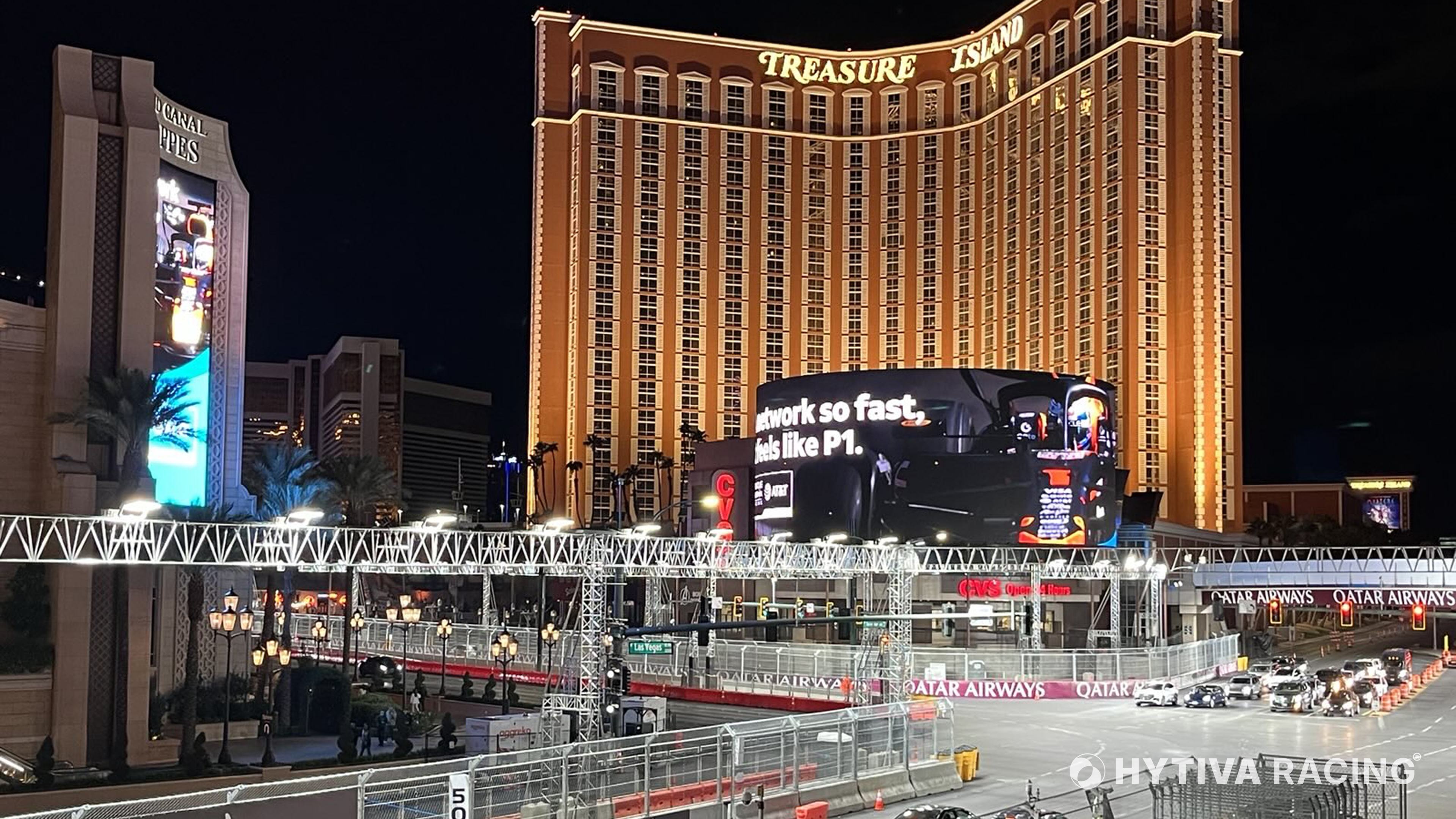
The lap begins with a tight left-hand Turn 1 after exiting the purpose-built pit lane. Drivers then flow down Koval Lane, sweep in a long right-hander around the glowing Sphere entertainment venue, and accelerate along Sands Avenue before hitting the iconic Strip straight. Here, the circuit passes directly in front of legendary properties including The Venetian, Wynn, Bellagio, Caesars Palace, Paris Las Vegas, and the Flamingo. The sight of single-seaters flashing past dancing fountains and giant LED displays creates imagery unlike anything else in motorsport.
After the long straight, the final sector becomes far more technical. A series of slow- and medium-speed corners along Harmon Avenue demands heavy braking and precise traction, followed by another half-mile straight and a fast sweeping left that returns drivers to the start-finish line opposite the new paddock complex.
On paper the layout looks relatively straightforward, but the combination of ultra-long full-throttle sections, brutal braking zones, and low-speed corners makes it deceptively challenging.
Unique Technical and Environmental Challenges
The circuit presents a classic compromise for engineers. To maximize speed on the two long straights, teams adopt low-downforce aerodynamic packages similar to those used at Monza. Yet the slower corners, especially in the final sector, require mechanical grip and stability that low-downforce setups typically sacrifice.
The street surface itself offers little natural grip compared to permanent race tracks, and the race taking place at night in late November means ambient temperatures often drop below 10 °C (50 °F). Getting tyres into their operating window—particularly on out-laps and after safety cars—has proven extremely difficult. Drivers frequently report sliding and locking up early in sessions until sufficient temperature is built up.
Braking consistency is another major factor. Decelerating from over 370 km/h into tight hairpins under constantly changing light conditions (from bright casino floodlights to darker sections) tests both driver skill and car balance to the limit.
Driver Reactions
Initial reactions in 2023 were mixed. Some drivers questioned the low-grip surface and cold temperatures, while others were simply awestruck by the visual spectacle. By the second running in 2024, however, the tone had shifted noticeably. With a year of data and experience, teams and drivers treated the weekend with the seriousness of any other high-speed challenge. Comments now focus less on the “Vegas show” and more on how to extract every tenth from the long straights and how to manage tyre temperatures across a stint.
The City as Part of the Show
No other street circuit integrates so completely with its surroundings. Monaco has yachts and casinos, Singapore has skyscrapers and humidity, but Las Vegas literally runs the track down the main boulevard of the entertainment capital of the world. The fountains of Bellagio dance just metres from the racing line and the Sphere projects giant visuals visible to both drivers and spectators.
Organizers deliberately scheduled the race for Saturday night to capture peak Vegas energy. The result is a sensory overload: roaring engines echoing between hotel towers, pyrotechnics, celebrity appearances, and concerts before and after the race. Yet despite the extravagance, the on-track product has proven genuinely competitive, with overtaking opportunities and rapidly evolving track conditions keeping strategy teams busy.
Logistical Feats and Long-Term Future
Building and running a Grand Prix on Las Vegas Boulevard requires extraordinary coordination. Months of road closures, hundreds of thousands of temporary barriers, and close cooperation with every major resort are necessary. A permanent 300,000-square-foot paddock building—the first purpose-built F1 facility in the United States—now stands as the centrepiece of the event.
With a contract running well into the 2030s, the Las Vegas Grand Prix is here to stay. Each year brings refinements: smoother asphalt in key areas, improved drainage, better lighting, and more grandstand options. Teams now arrive with extensive simulator preparation specific to the circuit, and drivers speak of it as a genuine test rather than a gimmick.
A New Icon on the Calendar
In just two short years, the Las Vegas Grand Prix has established itself as one of Formula 1’s marquee events. It offers something unique: raw speed under the brightest lights on earth, technical challenge wrapped in glamour, and a street circuit that feels both futuristic and nostalgic at once.
For casual viewers it is instantly spectacular; for dedicated fans it provides fascinating racing; and for the drivers it remains one of the most demanding weekends of the year. Above all, it embodies the direction of modern Formula 1—embracing entertainment on a grand scale while never compromising the sport’s competitive heart.