
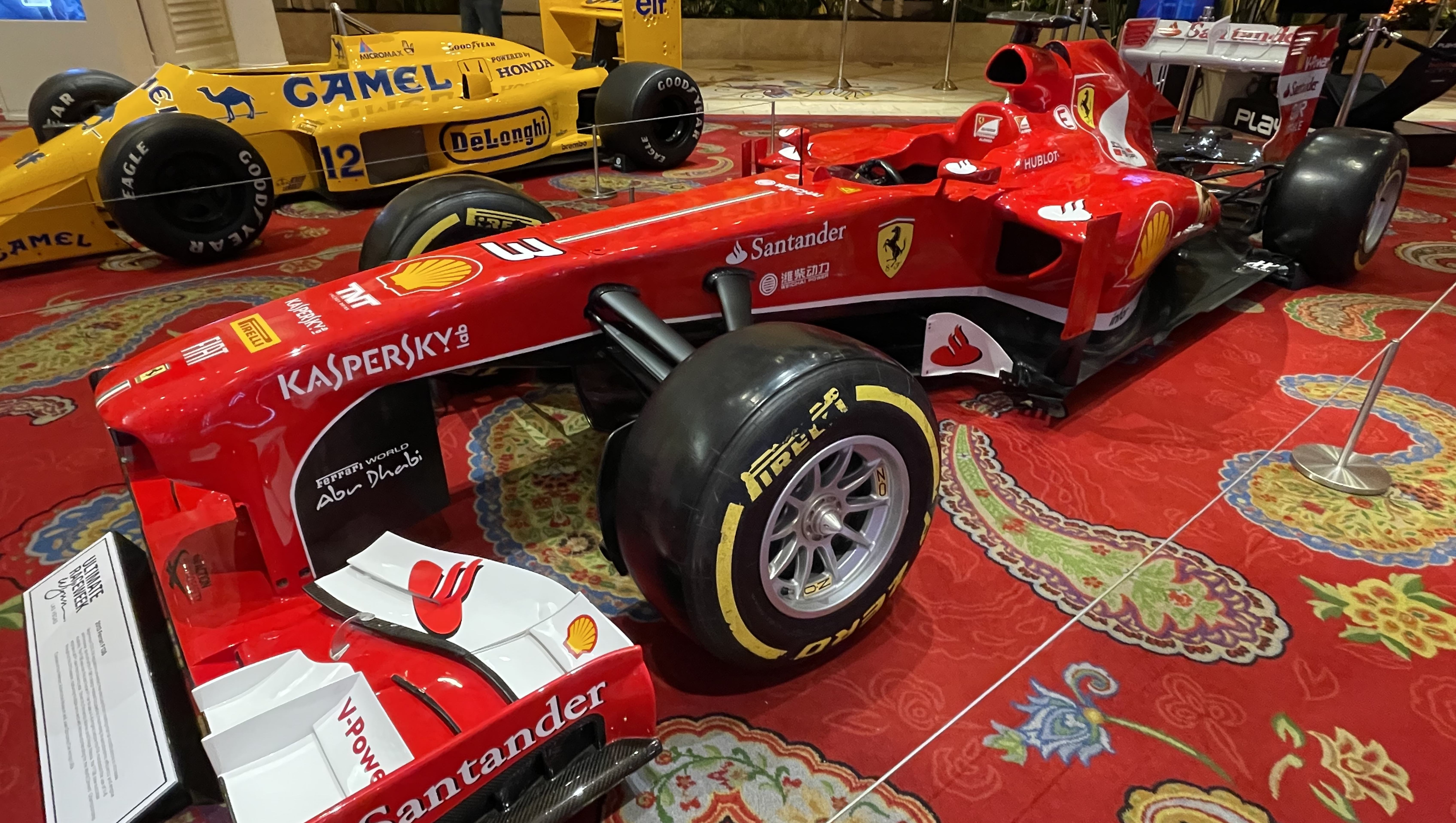
Ferrari’s 2013 F138: Aero Evolution and the End of an Era
A farewell to an era: examining Ferrari’s last V8 challenger before Formula 1’s hybrid future
The Ferrari F138 holds a distinctive place in Formula 1 history—not only as the Scuderia’s 2013 challenger but also as the final Ferrari to run a naturally aspirated V8 engine before the sport shifted to hybrid-turbo power. Driven by Fernando Alonso and Felipe Massa, the F138 represented the culmination of years of development within a tightly defined aerodynamic rule set, delivering strong early-season performances before ultimately falling short in the development race against Red Bull.
Design Origins and Technical Leadership
The F138’s name reflects its heritage: “13” for the 2013 season and “8” for the eight cylinders of the outgoing engine formula. Ferrari entered the season with a renewed commitment to start stronger than it had in 2012, when the team spent the early races recovering from an underdeveloped car. Design direction came from Pat Fry and Nikolas Tombazis, while Luca Marmorini oversaw engine and electronics.
In compliance with 2013 regulations, Ferrari used a vanity panel to smooth the F2012-era stepped nose—creating a cleaner aerodynamic profile. This minor but visually important change symbolized Ferrari’s aim for a more stable, predictable front end to support Alonso’s precise driving style.
Chassis, Aerodynamics and Mechanical Choices
The F138 featured a carbon-fibre composite monocoque and retained Ferrari’s rare commitment to pull-rod suspension on both front and rear. While most competitors used push-rod systems, Ferrari believed the pull-rod layout offered packaging efficiencies and aerodynamic benefits, especially around the front wing wake and rear airflow management.
Technically minded observers immediately noted Ferrari’s emphasis on aero efficiency:
- Highly sculpted sidepods improved downwash and airflow to the rear.
- A redesigned gearbox casing allowed for tighter packaging, increasing diffuser performance.
- An evolved Coandă-effect exhaust layout sought to maximize downforce within tightening restrictions on exhaust blowing.
- Multi-element front wing iterations were introduced throughout the year to further fine-tune front-end load.
Ferrari also addressed airflow management beneath the chassis with a carefully engineered under-nose duct, a refinement designed to stabilize aerodynamic performance in variable conditions.
The Final Ferrari V8
Power came from Ferrari’s final V8 engine: the Type 056, a high-revving 2.4-liter naturally aspirated unit capable of spinning beyond 18,000 rpm. Producing roughly 750–780 horsepower, the engine was celebrated for its durability and smooth power delivery. Fuel and lubrication systems were developed in partnership with Shell, which had long collaborated with Ferrari on F1 energy efficiency and performance.
Reliability became one of the F138’s greatest strengths. Through the entire 2013 season, Ferrari did not record a single race retirement due to mechanical failure, a rare achievement in modern Formula 1.
Season Performance: A Tale of Two Halves
Ferrari entered the season with confidence after promising winter testing. That optimism translated immediately into results: Alonso finished second in Australia, while both drivers ran strongly in Malaysia and China. The highlight came at the Spanish Grand Prix, where Alonso delivered an emphatic win in front of his home crowd.
By the fifth round, Ferrari appeared to be a genuine title contender. The F138 excelled in race pace and tyre conservation, crucial factors in 2013 due to the sensitivity of Pirelli’s compounds.
But the momentum wouldn’t last. As the development race intensified—particularly through the summer—Red Bull’s RB9 surged ahead. Ferrari introduced several upgrade packages that failed to deliver expected gains, especially at high-downforce circuits such as Monaco, Budapest and Singapore. Qualifying pace proved a recurring weakness, often leaving Alonso too far back to mount podium challenges despite strong long-run performance.
Still, Alonso salvaged an impressive campaign with podiums in Canada, Belgium, Italy and Singapore, keeping Ferrari in the fight for second in the Constructors’ standings until late in the season. Ferrari ultimately finished third, scoring 354 points.
Legacy of the F138
The F138 marks the end of an era. It was Ferrari’s last naturally aspirated Formula 1 car, concluding the V8 period that began in 2006. The car embodied Ferrari’s philosophy of evolutionary refinement under stable rules, combining mechanical reliability with aerodynamic sophistication.
While it never became a championship-winning machine, the F138 showcased Ferrari’s deep technical expertise and provided Alonso with a platform to deliver some of his most tenacious performances. In the broader context of F1, the F138 stands as a symbol of the sport’s final breath before the hybrid era transformed Formula 1 forever.