
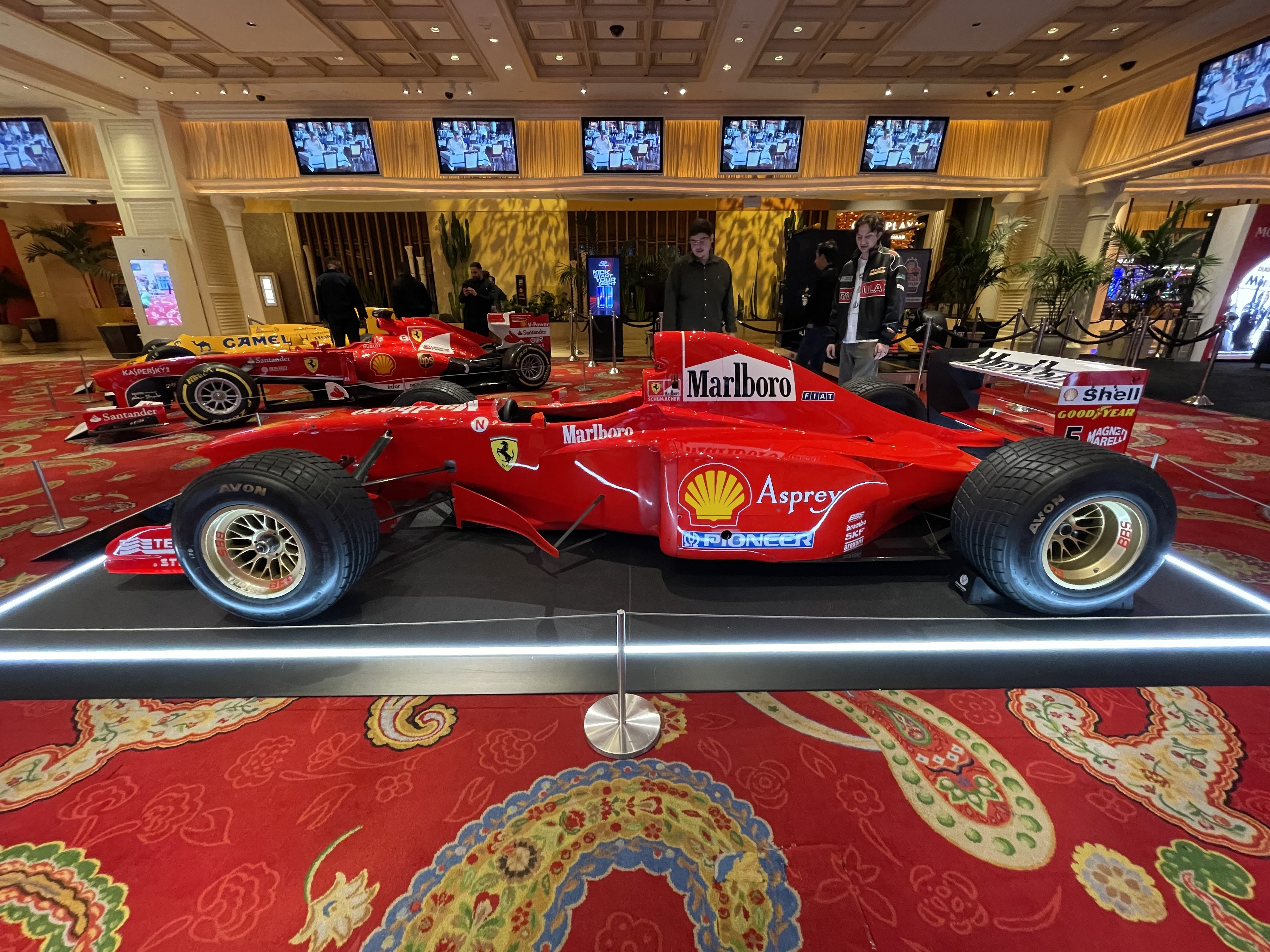
Chasing Williams: Ferrari’s 310B and the 1997 Title Battle
The Car That Put Ferrari Back in the Fight
The Ferrari F1 310B occupies a fascinating place in Formula One history. It was neither a revolutionary ground-up concept nor the dominant force of its era, yet it became the car that dragged Ferrari back into the title fight and signaled the end of a long rebuilding phase in Maranello. For a team still haunted by near misses and mechanical fragility, the 310B was the machine that finally looked and behaved like a championship contender.
Evolution, not reinvention
Ferrari entered 1997 with a clear brief: refine what worked and fix what didn’t. The outgoing F310 had shown flashes of speed but lacked consistency and trust at the limit. The 310B addressed that directly. Beneath its sculpted red bodywork sat a carbon-fibre and honeycomb composite monocoque, paired with push-rod suspension at both ends and a seven-speed electro-hydraulic semi-automatic gearbox—all familiar ingredients, but now better integrated.
Power came from Ferrari’s 3.0-litre, 75-degree V10, producing around 730 horsepower at over 16,000 rpm. In an era still defined by mechanical grip and driver feel, the engine’s delivery mattered as much as its headline number. Crucially, Ferrari achieved the minimum 600-kilogram weight with driver and fluids, leaving engineers free to chase balance and tire life rather than simply shedding mass.
The result was a car that inspired confidence—and in Formula One, confidence translates directly into lap time.
Schumacher and a car he could lean on
At the center of the project stood Michael Schumacher, already deep into his Ferrari mission. The 310B suited Schumacher’s aggressive, feel-based driving style: strong on turn-in, predictable under braking, and stable enough to attack kerbs lap after lap. It wasn’t always the outright fastest car, but it was rarely out of the window.
That consistency reshaped Ferrari’s season. Instead of chasing unlikely wins, Schumacher was now racing for points, podiums, and pressure—the currency of championships.
Defining victories
The 1997 season produced five wins, each telling its own story about the 310B.
Monaco was the tone-setter. On a circuit that brutally exposes any weakness in traction or balance, Schumacher controlled the race with authority, reminding the paddock that Ferrari could still master Formula One’s most exacting stage.
Canada followed, where the 310B’s stability over curbs and under braking proved decisive. France added another layer—a more conventional circuit where strategy, tire management, and clean execution mattered as much as raw speed.
Spa-Francorchamps was perhaps the most emblematic victory. In mixed conditions, Schumacher and the Ferrari looked unshakeable, slicing through the field and underlining the car’s adaptability. It was the sort of win that convinces rivals they’re facing something more than a weekend threat.
Japan, late in the season, kept the championship alive. Suzuka demands precision and rhythm, and the 310B delivered both when Ferrari needed it most.
A championship that went to the wire
Those wins ensured Ferrari carried the title fight all the way to the finale at Jerez. Schumacher arrived locked in battle with Jacques Villeneuve, driving for the formidable Williams outfit.
What followed is etched into Formula One folklore. A collision between Schumacher and Villeneuve ended the Ferrari’s race and ultimately Schumacher’s championship hopes. The subsequent disqualification from the 1997 standings ensured the season would always be discussed through a controversial lens.
Yet to focus solely on Jerez is to miss the wider picture.
Why the 310B mattered
Ferrari finished second in the Constructors’ Championship with 102 points—its strongest performance in years. More importantly, the 310B established a template: a car that could win on vastly different circuits, finish races, and apply sustained pressure across a full season.
It marked the moment Ferrari stopped rebuilding in theory and started delivering in practice. Within three years, the team would be entering one of the most dominant periods in Formula One history.
In retrospect, the Ferrari F1 310B wasn’t just a race car; it was a statement. Not perfect, not untouchable, but finally credible. And in the unforgiving world of Formula One, credibility is often the hardest victory of all.